firebroadside@gmail.com
Showing posts with label LotR. Show all posts

Sunday, 1 February 2015

Review of Hobbit Tales from the Green Dragon Inn

Let's take a break from the rpg reviews and take a look at a board game released by Cubicle 7 instead! It's called Hobbit Tales from the Green Dragon Inn and is a quick playing storytelling game for two to five players. It also ties into The One Ring roleplaying game (sorry, I lied about taking a break) where it can be used to enhance travelling or simply as a way to find inspiration on the fly.

The game was released in 2013 but I actually didn't get to play it until last year. I had been reluctant to bring it to our board game nights, for some reason thinking it was too much of a narrative focus for some of my mostly board game interested friends. Silly me! While it is certainly a storytelling game in the vein of Once Upon a Time or Dixit I don't think you need to worry about "not being creative enough" or anything similar.

It comes in a small box with some nice, thematic art on it depicting Gandalf and Bilbo smoking pipe and exchanging stories at the Green Dragon. There's some really neat detail in the frame of the picture depicting all kinds of adventuring locations and, my favourite detail, Smaug himself in the smoke ring around the Lonely Mountain. The same frame is used on the new The One Ring Revised core rulebook which is a nice touch. Of course the creators of this game, Marco Maggi and Francesco Nepitelli are also the guys behind War of the Ring, The Battle of Five Armies and The One Ring roleplaying game so it comes as no surprise that they're all linked not only through theme but also by layout, graphical design and art.

The basic premise is that you are hobbits drinking at the Green Dragon and competing about who tells the best story. You play the game in a number of rounds equal to the number of players so each player get a chance to be the Narrator, while the others are Hazard players. To play you use a small game board with slots for five tarot sized cards, Cheers tokens for points, some Green Dragon coasters to hide your points under, a 12 sided die and two decks of cards. And oh, what nice cards they are! Cubicle 7 made the great choice of printing them in tarot size which both allow the art to really shine and also bring a sense of "weight" to them that regular play cards lack. The cards are for all intents and purposes the heart and soul of the game and it's fun just flipping through them, looking at all the details and reading some nice Tolkien quotes! Part of me want to sleeve them while part of me doesn't as it would detract (ever so slightly) from the immersion and I'm also uncertain if they would fit back in the box if sleeved. Of course from a game play perspective it's pretty much meaningless as even if a card was marked it wouldn't really have any effect on the game.

Just doing a summary of the already brief rules and then write about my thoughts on the game I think would make for a very short review. So instead I'm going to run through a typical game and explain most things as we go along and tell a little story at the same time. This seems more enjoyable and probably gives a better sense of how the game actually plays.

Contents.
There are 75 Adventure cards used by the Narrator and 40 Hazard cards used by the Hazard players and they are all unique. Adventure cards can represent all kinds of things but generally they're locations, events, meetings or feelings while Hazard cards are dangerous events, locations, items or monsters. The art range from pencil sketches to full colour paintings and I have yet to find one with "bad" art! You know I've talked about how great the books for The One Ring looks, mostly thanks to the art, and this is like having all that art concentrated in 115 cards and it's great. I could go on about this, but let's just stop here and get on with it. :)

The Game

You start a round with the Narrator drawing four cards from the Adventure deck, which she looks at and quickly try to form a loose narrative in her head. She then draws two more cards and chooses one card to be the Opening, which is placed face up to the left on the board, and the other the Epilogue, which is placed faced down to the far right of the board. The Hazard players draw cards from the Hazard deck depending on the number of players - in this example there are two Hazard players so they draw three cards each.


The Narrator draws Ancient Trees, Adventurous, A Short Rest and Old Sword, and a skeleton of a story forms in her head - something about going on an adventure, and finding a sword and bringing it back home. The Opening and Epilogue turns out to be Lost Reputation and Many Meetings and she decides to play them in that order.


The Hazard players draw Great Orc, Werewolf and Bitter Cold plus Bear, Nameless Horror and Two Headed Troll. They look these over and spend some extra time checking the Terrain icons in the lower right corner as these decide when the cards can be played.


The Narrator begins her story about that time a few years ago when her pipeweed experiments went a little too far and the good people of Hobbiton thought her an odd individual indeed. To prove her detractors wrong (and to simply get away from it all for a bit) she decided to go on a bit of a trek in the surrounding countryside. Nothing too adventurous but enough to perhaps bring some interesting stories from afar, or maybe some new ingredient for her pipeweed!

At this time the Hazard players check the Terrain icons on the two Adventure cards played so far and see if they match up with any of their Hazard cards. If the two icons on a given Hazard card match any of the icons on the lats two played Adventure cards the card is playable - so far we have two Woods icons and a Wilds icon... which don't match any of the Hazard cards. The Hazard players rap their knuckles on the table to signal for the Narrator to continue, which she does...

"I hadn't gone far when I saw something lying on the road... an old sword! I looked around to see if I could see who might have dropped it, but besides horse tracks there was nothing to be found!". With the addition of the Evil Eye icon on the latest Adventure card the first Hazard player has a card with a match! He clears his throat and asks; "This was when you went on your trek in the middle of the coldest winter the Shire had seen in two decades, wasn't it?" - sliding his Bitter Cold card toward the board. Normally he would have to roll the Hazard die at this point and try to match or beat the number in the lower left corner of the Hazard card. However, as the Adventure card played, Old Sword, has the Eye icon on it the roll succeeds automatically and the card takes effect. In this case the Hazard player get to draw a Cheers token and either place it under his coaster or on top of it to signify that he's "buying another round". Next, the Adventure card is not placed on the board and the Narrator has to incorporate the new twist from the Hazard card in her story in some way.

"Yes, it wasn't really the best time to go for a stroll that's for sure! I picked up the sword and tried to follow the tracks in the snow, but with the snow still falling there were soon no tracks left and I ended up scratching my head about what to do next." As there can only be one successful Hazard card played per turn, she plays the next Adventure card...


"Although I almost felt like returning home at this point, the hubby had been making biscuits as I left after all, something in me pushed me on and I managed to find shelter from the wind and snow in the hollow of an old oak tree." She plays A Short Rest and looks expectantly at the first Hazard player who raps his knuckles on the table. The second player slides his Two-headed Troll toward the board and says; "Oh, I remember this story! You didn't notice it at first, but there was a sleeping troll in the hollow, wasn't there?!". However, he rolls a two so the card fails to take effect; "No, no, silly! You're thinking of the troll that slept in Old Bogg's wine cellar the winter of 34!".


"Now, having eaten and rested for a bit I felt my strength return and continued, while the old sword was an interesting prize I felt there was even more impressive things ahead. The snowfall ceased and it wasn't long until I found myself at the edge of the Old Forest". She plays the Ancient Trees card, which has another Eye on it, but luckily the Terrain icons don't match and both Hazard players rap their knuckles grumpily on the table. At this point the Narrator don't have any cards left, and has to Improvise to try and complete her story. Improvising is done by simply drawing the top card of the Adventure deck and incorporating it into the narrative. You can keep improvising until a Hazard card is successfully played, in which case your story ends.

The Narrator draws the top card of the Adventure deck and thinks for a bit while inspecting it, recalling the maps of the area around the Old Forest. Then she continues; "Knowing very well not to set my foot in the haunted woods I decided to skirt around it, seeing if there might be something interesting on the other side. And indeed there was! The land beyond the forest was made up by a series of hills, each looking a little too perfectly formed to be natural. I pulled my coat around me as I shivered in the cold while moving in among the hills. It wasn't long until I found one with a large door in it. Not a nice round hobbit door mind you, but a big and imposing one made of stone, steel and rotted wood." She plays the Tomb card while the first Hazard player raps on the table the second quietly whispers; "This is perfect!" as he slides the Nameless Horror card forward.


"I bet that was a really bad idea! I've heard horrible things about the Barrow Downs!". The Hazard die ends up on seven, meaning the Tomb card is removed from the board, the Hazard player takes a Cheers token and the Nameless Horror takes effect. "Well, at this time I hadn't so I had no idea what waited inside. I thought I would seek shelter in there but it proved even colder as I closed the door behind me. My torch sputtered in the darkness and the hair on the back of my neck stood on end as I heard a slow, wheezing ahead of me. I called out for whoever it was that we could perhaps share the one muffin I had left, but got no reply. That was when I saw... or felt something coming toward me. Darkness and horror! I turned and fled out in the snow and ran for a long time! I don't even remember exactly what happened but I ended up running straight into one of the Brandybucks, Will I think, who invited me in for some hot tea." 


Having failed to Improvise the Narrator's story has come to a premature end, since she has not been able to completely connect the Opening with the Epilogue card. This means that she must now turn over the Epilogue card and conclude the narrative in a negative way, as if the story didn't end as the Narrator had hoped it would. With the Epilogue card being Many Meetings she continues; "It wasn't until I'd had my fourth cup of Brandybuck tea that I realized that I had dropped the sword when I ran! I didn't even have anything to show for my trouble and while I was, of course, thankful for bumping into a Brandybuck and him letting me stay at his house I was stuck there for two weeks while the weather turned even worse and was introduced to every brother and sister, every uncle and aunt, every cousin and nephew and it all made me both weary and bored! My return to Hobbiton wasn't anything like I hoped and they still talk about me as "that weird pipe lady". If they only they'd know what I have been through! Hmpf!!"

Applauds from the rest of the table as the Narrator takes a bow and start to check her score. You get to draw one Cheers token for each card on the board and one extra if you manage to reach the Epilogue and achieve a full ending. As this story ended prematurely with a total of four cards on the board (of course, not counting the ones removed by Hazards) she draws four Cheers tokens which, to add insult to injury, turn out to be all ones! She puts three under her coaster and one on top to "buy the next round".

Once all players have had a chance to narrate a story you decide the winner by counting all the Cheers tokens under your coaster then you check who has the most points on top of his coaster as this player get a bonus four points for buying the most rounds of beer! There are also rules for giving some extra points for the best story and there are some card icons that can come into play during the game that is not part of this example - like the Hazard players getting to draw extra cards - but this should give you a pretty good idea on how the game plays!

You might also have noticed that there are some other icons on the cards, diamond shaped like the ones in The One Ring and War of the Ring. These don't have any function in Hobbit Tales, but can instead be used in The One Ring roleplaying game. While any of the cards can be used by the Loremaster to quickly get some inspiration for an upcoming scene there are also structured rules on how to incorporate them during Journeys. The left icon tells you which role is affected (guide, scout etc) while the right tells you the effect of failure and the card itself provides inspiration for the narrative that the Loremaster (or the affected player) presents. Basically it's a replacement for the Hazard table that is in the new Revised Core rulebook and I think it will certainly help to bring some more unique hazards into play.

Thoughts

So, what are my thoughts on the game? Well, it takes about 20-30 minutes to play and has so far provided some great Tolkien-esque short stories that has made me want to break out my roleplaying books so... two thumbs up! As I mentioned above I was a little worried that it would be too much of a narrative game for the regular board game night, and during our first game Claes was hesitant to be the first Narrator out of the gate, even though he's an old roleplayer! Weird I know, but I think it has to do with having to think on the spot and make at least a semi-coherent narrative. These were all silly things to worry about though as we all spun some great stories without breaking a sweat. The combination of card title, art and quote either (or all) of which could provide the inspiration needed to connect the next link is more than enough to get your imagination gears turning. Does it help if you are a roleplayer or enjoy improv? Sure, but it's absolutely not needed.

The game has been a great success and so far we have ended up playing two or three games back to back as everyone has wanted another chance to tell a story. Once we even had a player who was just about to leave but watched a game in progress and decided to stay longer so he could participate in the next two rounds! Still, even if this was just a collection of large sized art cards with images inspired by Tolkien with no game attached I would have got them anyway. Beautiful art and great sources of inspiration! The only thing I feel could have been done better from a design perspective is the Terrain icons as they're done in a different style than the rest of the art on the cards. I understand the need to have these stand out and be easy to spot from across the table, but the kind of semi-photographic effect looks odd next to the rest of the card. There's also a slight shortage of Cheers tokens and you might end up having to resort to writing your score down, or use alternate rules posted by Francesco.

If you own and play The One Ring I think this is simply a no-brainer. Get it. If you're a great Tolkien fan I think you should get it as well, especially if you enjoy narrative board games that has seen a rise in popularity lately. I can't really comment on how well it measure up to other games in this genre as this is the first I've played, but to me the theme is what really makes it all come together and having a decent feel for Tolkien made it really easy to come up with a fun story. The game mechanics work well and it's fun both being the Narrator and a Hazard player, but in the end it's not a game you play to win, but play to experience some great stories set in Middle-Earth!

No comments

Saturday, 24 January 2015

Review of Rivendell for The One Ring

Alright, enough with all the mechas and power armoured anime dudes! Let's get back to the Season of the Ring and the the first review of a The One Ring book, namely the just released Rivendell by Cubicle 7!

Rivendell is a new hardback sourcebook for The One Ring that weighs in at 144 pages and it marks the series first foray outside of the original setting of Mirkwood and its surroundings that is the default adventuring area for the core book and the supplements released so far. Originally the plan was to release three core books, each focusing on different geographical areas of Middle-Earth, but this idea was later abandoned in favour of releasing sourcebooks like this one to fill in the blanks and provide extra cultures fitting the setting.

Although the original core book for the game was released back in 2011 the release schedule since has been rather slow and somewhat erratic. Most of this has apparently been the fault of the Tolkien estate who need to check that everything looks ok to them and they can at times be a little slow and other times request changes to be made further prolonging the process. I don't fault Cubicle 7 at all in this regard, but can understand players who felt frustrated during the first couple of years. Now however, it seems like things are picking up a little and with the release of the Revised rulebook it feels like the game has got into it's second breath!

I'll take the time to make a mild SPOILER warning here. Although I'll talk mostly in generics it might be wise to avoid this review if you are a player in a The One Ring campaign and want to remain completely in the dark of what is to come.

Rivendell is of course of extra interest to anyone who has wanted to explore the world beyond Mirkwood and the Misty Mountains and it does not disappoint in this regard. At the moment I only have access to the PDF of the book so can't really comment on its physical appearance, but it's hardback and I'm guessing it's similar to either The Heart of the Wild or The Darkening of Mirkwood (they're slighly different in that Darkening is matte while Heard it gloss). From what I can tell there are no loose maps included with the book, although you get them as separate files with the PDF. I imagine they will be part of the upcoming Journeys and Maps supplement. When I get my hands on the actual book, I'll update this section with more details on its physical appearance. By now I don't think I need to mention that the book is absolutely beautiful with spectacular and immersive art by Jon Hodgson, Jan Pospíšil and Jeremy McHugh. I mean, it goes without saying, The One Ring line of books is famous for their art and graphic design! Taking a quick look at the contents we have: Introduction, Imladris, A History of Eriador, The Regions of Eastern Eriador, New Monsters, Magical Treasure, The Eye of Mordor, Heroic Culturs and Appendices. So let's dig deeper and see what each chapter brings to the game!

The Introduction is, well... an introduction, but it also explains that Rivendells it the companion book to the upcoming Ruins of the North, much like The Heart of the Wild is the companion book to The Darkening of Mirkwood. That being said, I suspect Ruins of the North will be more similar to the adventure compilation/mini-campaign Tales from Wilderland that the epic play experience that is The Darkening of Mirkwood. It is also explained that the book is written with the year being some time after 2951 and possibly as late as 2077 (the default ending year of the The Darkeing of Mirkwood campaign), however it is also stated that things change slowly in Eriador and if you want to set your campaign earlier few things would need adjusting.

Imladris, Rivendell, The Last Homely House.
The chapter on Imladris is 15 pages of Rivendell background and information, including its history, a map with just the right amount of detail and a number of key characters who reside there. I have never been all that interested in Rivendell myself (unlike many others) as it has somehow felt almost "too good" a place to be in. I want my adventures to be muddy and dirty! Haha! Even so I found myself re-evaluating my position on the Last Homely House and am now actually looking forward to having my players find and explore it (some time in the far future once we're "done" with Mirkwood). Good chapter with just the right amount of information to craft good story hooks and get ideas, but not being overburdened with minutia like what exactly each room is used for and looks like.

The next chapter, A History of Eridador, is quite short at only six pages, but you should be aware that a lof of the history has also been baked into the gazeteer in the next chapter. You get a rundown of the rise and fall of both Arnor and Angmar, how the rangers formed and how they are pretty much keeping the entire region safe from orcs, troll, wargs and other even worse servants of the Shadow! While not a long chapter it provides a solid overview of the events which should be easy to relay to the players when required.

Now comes the real meat and potatoes of the book in the form of The Regions of Eastern Eriador. That's right eastern Eriador! You see, Cubicle 7 has plans for the western parts (which apparently includes the town of Bree and its immediate surroundings which are not covered in this book) and the Rivendell book covers the region from the Misty Moutains in the east to the Barrow Downs in the west. Just like The Heart of the Wild this chapter is a kind of gazeeter of the entire region with each section zooming in on a particular area (ie. Angmar, Mount Gram, Trollshaws, South Downs, Eregion etc). Each area gets between three and five pages devoted to it and after a general overview we get a subsection on wildlife, inhabitants, notable characters and notable locations as well as some special rules like new Fellowship Undertakings here and there. These chapters are pure gold for an industrious Loremaster as each of them could easily be spun into several sessions worth of adventuring! Generally each region has around three obvious hooks, but the general background certainly provides inspiration for creating more.

One thing this chapter really succeeds with is instilling a sense of how the Companions are moving through the ruins of an ancient and great kingdom. Not only through the snippets of history inserted throughout the text but also when talking about the ruins of towers, forts, statues and roads that litter this part of Middle-Earth. While a Ranger or Elf might know about most of these I would love to have a Company totally ignorant of the history of the region to kind of slowly piece everything together.

The 18 page chapter on New Monsters starts with a section about Powerful Adversaries which describes how to grant some of the new, powerful special abilities to existing monsters to bring their threat level up. It's also mentioned that some of these abilities already exist on a number of the new monsters of Eriador. Again, it is half-assumed that the group who has played enough to make their way across the Misty Mountains to Rivendell will need some tougher opposition to go up against. That is not to say that all the new monsters are super deadly, there are certainly normal level enemies in this chapter as well. Provided are both stats for some of the named monsters and adversaries that is mentioned in the previous chapter, like Bloodstump the Hunter, as well as generic creatures like Goblins of Carn Dûm and Hill-men of Rhudaur. Fitting the lost realm of Arnor, there's also an extended sub-chapter on the undead which lists a number of different variants as well as several pages on The Lord of the Nazgûl, aka The Witch-King which makes for interesting reading. The authors are however quick to point out that:
"While precise definitions are generally something to be desired in a game, sometimes they provide an explanation to things that should remain inexplicable, robbing a legendary world of its mystery. Keeping a level of uncertainty and providing only glimpses of a world that defies understanding goes a long way in preserving a sense of wonder in those who take part in the game."
Which is very much in keeping with my own view on the matter - again showing that they have a firm grasp on what makes Tolkien Tolkien. Basically the New Monster chapter provides exactly what you'd think it would, with some extra additions here and there.

Of course, powerful adversaries calls for some more extravagant rewards and Rivendell provides in the form of a 19 page chapter focusing on Magical Treasure. For those of you sharpening your pitchforks, checking your supply of torches and frantically trying to find Cubicle 7 HQ on the map, don't worry - there are no +2 maces or swords of advanced fireballs. Again Francesco and his co-writers show their adept feel for the setting and how Middle-Earth works. Mechanically speaking the main new addition is that of Hoards. A Hoard is not simply some regular treasure to be used up by the Companions but also have the chance of containing Magical Treasure. In Rivendell and every forthcoming TOR release the Treasure rating is expressed as a number plus zero to three asterisks to show if it's a Hoard with potential magical items in it. For each asterisk you can roll to try and find something special and you succeed on the Will of the West or the Eye of Sauron (the latter, with complications, naturally) and you can then roll further dice, based on the number of unspent experience points you have, to see exactly what you have found. If it turns out to be a Precious Object, Wondrous Artefact or some Famous Weapon or Armour (the four categories presented) you need to actually spend experience to get it.

This acts both to make magical treasure costly, to make it rare and to tie it specifically to the character that finds (and invests in) it. It's explicitly stated that these kinds of items aren't meant to be passed around at will or given to the character who could use it best (from a min-max perspective) but that it was meant to be found and carried by that very character: "After all, it was Bilbo who was meant to find the Ring, not Balin, Gandalf or Thorin." The items are also not meant to be random or made up on the spot, but rather prepared by the Loremaster before hand. Included in the book are sheets for making a Magical Treasure Index where you can compile a list of lost items that might be found in the area; their stats and bonuses as well as their individual history that might be revealed through a successful Lore test or a fitting Trait. I really like this idea as all the magical items featured in the books have a long and glorious history to them! And even if the exact details of an item is unknown (like Sting) you can still figure out the general history of it - where it probably was made and when. With the great and sad history of Arnor it certainly feels more likely to come across something out of the ordinary in Eriador rather than Mirkwood. Besides including instructions for how to create each of these objects and how many to incorporate in the campaign there are also rules for cursed items (remember that Eye of Sauron you might roll?) as well as a complete sample Magical Treasure Index for Loremasters who lacks the time to create their own.


Following this is a shorter chapter about The Eye of Mordor which is a new mechanic introduced in Rivendell to track how well the Company manage to avoid attracting the attention of the Enemy. The basic value to track is the Eye Awareness rating which moves up and down depending on the size of the Company, what kind of members it has and what it's doing. High Elves and Dúnedain attract more attention than men or, especially, hobbits. The starting Eye Awareness level is then continually modified during the Adventure Phase by rolling Eyes of Sauron, gaining Shadow or blatant use of magic. Of course the Loremaster could raise it further because of the actions taken by the players. When the Eye Awareness raises above a preset level (depending on their current location) - the Hunt threshold - the Company is considered Revealed, instead of Hidden. When this happens the Loremaster will introduce an especially dangerous event to inflict on the characters and then the Eye Awareness rating reset. Being revealed is not meant to trigger some artificial event like, "suddenly ten orcs appear and attack" but should rather be integrated with the current narrative and should generally be used to make the situation worse - if the characters are in dire need of allies and seek for help in a nearby village they're regarded with suspicion and hostility, the skies that seemed to clear up suddenly turn dark and the Companions are drenched in a downpour far out in the wilds, an enemy etc. It is also suggested that you can use the cards from Hobbit Tales from Green Dragon Inn for inspiration if you have that game (which I will review soon).

While this system is completely optional and easily something you could organically create as you play I still quite like this mechanical approach to it as it will make the players think twice about certain courses of action. It's generally aimed at campaigns taking place later in the timeline that the core book, when the Enemy is awake and actively searching, but I think it could easily be introduced in any time where keeping a low profile is of importance.

Finally we have the two new Heroic Cultures - the Rangers and the High Elves of Rivendell. From the start it is emphasized that these are not ordinary cultures like those we've seen so far for the game. Indeed the Rangers are all descendants of the Dúnedain and the High Elves lived long and seen much. Because of this they are intentionally made in ways that break the mold a bit and are on par with already experienced characters hailing from the Wilderlands. The authors also don't recommend more than one or maybe two of these powerful characters in the Company lest they unbalance the carefully wrought intention of having "regular people" step up and become heroes. I think both offer some very interesting roleplaying opportunities and they also have drawbacks to keep them somewhat in check.


Rangers have the Allegiance to the Dúnedain to keep in mind which makes them loners in the world of men, meaning that while they contribute normally to the Fellowship pool, but is not allowed to spend Fellowship points to recover lost Hope. Fellowship focus works as normal though. They have a really cool Cultural Blessing called Foresight of their Kindred which gives them a Trait called Foresighted that, that can be invoked like a normal Trait and will then be available for the entirety of that session, but then not again until the next Adventure Phase. So basically it works like a kind of danger sense that might tell you of what lurks ahead but that can only be used during one session per Adventure Phase, making it both powerful and tricky to use (do I invoke the trait now, or might there be an even more fitting occasion later?). They start with higher stats than a normal character but kind of makes up for it with the Allegiance to the Dúnedain and the fact that it costs more for them to raise their skills with experience points (reflecting that they're already quite experienced). The background packages are diverse and inspiring - supplying a variety of archetypes instead of the typical Strider-wannabe broody ranger that I think it's easy to fall into the habit of playing. My favourite is probably the Keeper of Earth and Spirit who has a kind of Radagast vibe and knows every plant and animal in Eriador and always have just the right thing to help with an ailment. Neat!

High Elves of Rivendell are especially marked by the Shadow and can't simply forget what has happened to them in the past. This means that they have an interesting way of handing Shadow points as they can't use the Heal Corruption undertaking in the Fellowship phase! Instead they can distance themselves from the past as an undertaking. You do this mechanically by marking one of your Common skills (preferably with a little Eye!) and for each point in that skill your Shadow score is lowered by two. The problem is when you later use that particular skill and happen to roll an Eye of Sauron - when this happens the test will fail automatically and you'll get a Shadow point. Basically you are overcome with sorrow of things lost and can't bear yourself to complete the task. I really like this mechanic as it makes High Elves very different from other Cultures and will make them slowly turn from the world in front of them (as more and more skills become marked) and think about leaving for the west. Their Cultural Blessing is called Agains the Unseen and lets them see spirits and wraiths that might be invisible to others, as well as not having to take tests to avoid Fear.


They also have a new trait called Enemy of Sauron which means that the servants of the Enemy instantly recognizes you for what you are and fear your presence. They will only attack if they have a proper advantage. Vice versa, it also means you have to take action when you see evidence of the work of the Enemy. The different backgrounds provide good inspiration for aspiring High Elves, with archetypes like the Elf-lord, Heir of Gondolin, Counsellor of Elrond and Vengeful Kin to choose from. Both cultures of course have some really neat Virtues and Rewards to choose from. The High Elves in particular can learn elven-smithing and craft enchanted weapons, which is pretty cool!

Finally we have the Appendices with the different sheets, the maps and the index. Nothing majorly exciting here. :)

Thoughts

As I mentioned above, I have never been all that interested in Rivendell as a place so even though I was looking forward to this book simply as one in a great series of The One Ring supplements, I would probably have preferred the Rohan book first, or maybe even more dabbling with spiders in in the dusk of Mirkwood. The area of Eriador also felt a lot less open than Mirkwood and more restricted in what you could do with it as a Loremaster. But, I'm happy to report that my fears and prejudices were entirely unfounded. In fact my perception of the region have changed a lot from reading the book and there's certainly a lot more to it than Rivendell and the Rangers. While I'm still partial to Mirkwood I've also become eager for my players to explore this land of spirits and lost realms.

The two new Heroic Cultures also manage to do a lot more than I had expected and I think a Ranger or a High Elf could be a very interesting addition to a company from the Wilderlands. They might demand a little more of the players though as at least a passing familiarity with the history of Eriador is almost required to really get the feel across right.


While the more mechanically focused chapters are good, and I'm especially impressed with how they handled the "problem" of magic weapons in a Tolkien setting, my favourite chapter is The Regions of Eastern Eriador. Just like The Heart of the Wild this gazeteer style chapter packs enough info to keep you busy for a good long while. If I were to nitpick I would have liked some zoomed in maps on certain of the places mentioned in this chapter. There are quite a few different ruins mentioned that would make for good mini maps to fold into the text. Then again, I have a feeling we'll see this kind of stuff in the Ruins of the North adventure supplement that's out next for The One ring.

I also feel it's slightly odd not to include Bree-land as part of eastern Eriador as it's as far or even farther east than the Lone-Lands and the Barrow Downs. While I can understand the desire to include it in the book covering the Shire and western Eriador (that way keeping a kind of thematic parallel with the part of the journey the hobbits made themselvs in LotR) it still feels strange to leave out the only proper village/town in the entire region, apart from Imladris. Not having actual fold out maps included with the book (please correct me if I'm wrong on this) is also a bit of a bummer.

Still, these small niggles aside I think this is an excellent addition to The One Ring and it's exciting to see the world open up for continued adventures in Middle-Earth!


2 comments

Monday, 22 December 2014

Review of The Battle of Five Armies


As I mentioned earlier I wanted to start the Season of the Ring with a bang, so what could be better than a big boxed, extravagant board game like The Battle of Five Armies?! Ares Games were kind enough to send me a review copy of the game and here are my thoughts on it...

The game was released earlier this year by the guys at Ares Games who made War of the Ring and Age of Conan among others. You can immediately see that it shares a lot of things with its older sibling War of Ring, both mechanically and visually, however it is certainly a different more focused experience. In the wake of the success of War of the Ring Nexus Games released Battles of the Third Age back in 2006 which was both an expansion to the base game as well as a completely separate game where you could play out the sieges of Helm's Deep and Minas Tirith in greater detail. It has been out of print since Nexus went under but The Battle of Five Armies is a kind of reboot of the latter sub-games. Of course, being its own game it has been expanded and improved upon with a lot of mechanics dedicated to the specific battle.

What You Get in the Box

I forgot to take a picture of the contents so borrowed this great image by Uthoroc at bgg. This is the German version mind.
Let's just take a quick look at what you get in the box. First off there's the very nice looking board. It's about half the size of the War of the Ring (WotR) board and features art similar to the second edition. That is to say, it doesn't feature the semi-parchment style of the map from the first edition of WotR, but rather the more naturalistic art of the second edition. The region border lines are also clearly drawn, but only in white. The different territories on the map are instead colour coded in the small terrain icon in the middle of each region. There's the Valley with the Ruins of Dale in the middle, the mountains and hills of the Southern Spur and Eastern Bank to the south and north and the Broken Lands to the east. Clearly marked are Mustering Points for the Shadow Armies, as well as fortifications and settlements for the Free People. At bottom right there's the Fate track that works as a timer for the game and also signifies when certain Free People characters enters play. All in all the map is both gorgeous to look at and very functional in play. I think it finds a nice balance between the boards of the first and second edition of WotR.

Then there's a bunch of cards. Some larger ones with stats for the different heroes of the game as well as the eagles and bats, and the rest regular board game sized cards making up a few different decks. There is a deck of event cards, two decks of story cards (Shadow and Free People's respectively), a thin deck of fate Cards and a bunch of maneuver cards. An assortment of tokens, using the same iconography as in WotR and The One Ring roleplaying game (also by Franceso Nepitelli of course) rounds out the cardstock portion of the game. Then there are some fate dice, some regular dice and two well made reference sheets.

Oh, and a mountain of plastic of course! Hehe! Most of the sculpts are being reused from WotR and Battles of the Third age with "only" the bats, eagles and characters being unique to The Battle of Five Armies. The characters in particular look great and are, in my opinion, a clear step up from the character minis in War of the Ring. I'm especially fond of Thranduil, Gandalf and Bolg! The regular army figures holds a decent standard and has a nice pre-movie vibe to them that in a paradoxical way feels fresh in this day of mass-marketed Tolkien. The painter in me really wants to take the brush to these minis as that can enhance their look even more. There's just so much other stuff to paint!


The rulebook is written in a clear and concise way which is a joy to read! It's certainly nice to see that Ares have learnt from their mistake with the original WotR rulebook that was a bit fuzzy in places and not very well organized. After a few turns you won't really have to consult the rulebook at all since all the pertinent information is included on the reference sheets.


The Rules

Like usual I will only provide a cursory glance at the rules as the actual rulebook is available online for those who really want to get down into the nitty-gritty.

A central part of the game is the Fate track in the lower right corner as that basically works as a timer. If it ever reaches 15 the Free People win the game and if the Shadow player manage to get 10 points or more by capturing settlements and fortifications she wins. The Free People can also win by killing the Shadow leader, Bolg, or if the Shadow player hasn't managed to get six points by the time Béorn enters play. Speaking of which, during setup you place a number Free People characters at different spaces on the Fate track and when the Fate marker reaches each respective number that characters becomes ready to play into the game. What all this means of course is that the Shadow player is working under pressure and really need to get to it before more reinforcements arrive for the Free Peoples. Bilbo, who is more of a utility character, doesn't seem to dangerous but when Béorn or the eagles turn up you wish you'd pressed the attack!

The first turn. The Shadow player is advancing and you can clearly see the facedown Recruitment tokens.

A turn starts with the Free Peoples player activating up to three of his general characters, to ready their special abilities, and placing Leadership tokens on the board. After this the Shadow player draws one or more Fate tokens to see how far the Fate track advances. These two things are connected as the Shadow player get to draw as many tokens as the number of activated generals, but has to use the last one drawn. This makes for a neat push your luck mechanic (for both players) as the more generals activated the greater the chance the Shadow player has to draw a tile with a low number on it. After this it's time for the Leadership phase of the Shadow player who gets to add Leadership tokens to her armies as well as add Great Bats to the board.

After these preparations comes the Action Round which is the meat and potatoes of the game where both players get to roll their respective Action Dice and take turns using them to move their armies around. The dice are the same as in War of the Ring and anyone who has played that game will have a rough grasp on how they're used. Of course, with a much narrower focus comes a bunch of changes as well. Basically the dice can be used to move and attack with armies, move heroes or armies lead by a hero, muster new troops or play Event or Story cards. There are several nuances that differentiate how the different dice are used; for example, while both the Army and the Character symbol allow you to move and attack with armies the Character symbol allow you to move two regions first, instead of one. On the other hand, the Army symbol allow you to move two of your armies one region each (without attacking) or can be used for a devastating combined attack where you use two of your armies to attack a single enemy army.

The goblins break through the mountain pass and spill down the side of the mountain!
The Muster symbol is used to flip Recruitment tokens that are already on the board, or to Rally (heal) your armies. Recruitment tokens is another critical part of the game and come in three flavours: Dwarves & Men, Elves and Shadow. The board is seeded from the start with a number of tokens but during actual play the only way to get more out is to use certain character abilities or some Event/Story cards, meaning you can never count on a steady stream of reincorcements. The Shadow player has it a little easier in this regard as Bolg has a way of getting Recruitment tokens fairly reliably (still, he's going to need them!).

Besides normal Mustering the Shadow player can also use the Lidless Eye result to build up his goblin armies who are scaling and/or tunneling through the mountains. These mountain passes are closed when the game begins, but when there are five or more goblins in a pass it is broken through and they are free to start rampaging down into the valley! It's a very satisfying feeling when you suddenly can attack from almost within the midst of the enemy. Hehe!

Finally there's the Event symbol that you can use to draw or play cards. You can play any card with the Event symbol, but all cards also have at least one alternative symbol you can use to play that specific card. For example, if the card allow you to place Recruitment tokens it's a fair bet that it could be played with either the Event or the Muster symbol. Event cards, which are common to both players, usually have fairly generic effects like allowing a bit of extra movement or bonus to rallying while the faction specific Story cards often have more powerful effects. Of course, the Event cards can also be used during battle (more on that below).

After both players have used all of their Action dice you do a bit of board cleanup and start another turn.

Battles

Some men of the lake fire at the oncoming hordes using the great looking measuring tool! We saw this kind of measuring tools back when Android was released but I haven't seen it again until now. Love it though! Oh, and for those who know the game, yes this is an illegal move as the Lakemen aren't in hill or mountain terrain. :)
Since combat is a bit more involved in this game than the Risk-like style of War of the Ring I thought it warranted a section of its own. An army can consist of up to five miniatures plus eventual Characters and Leadership tokens. You move them around the board using your Action dice (and you can of course combine or split armies) and when adjacent to an enemy army you can attack it. Each of the different units in your army has their own specific Maneuver card with their stats, Favoured Terrain icon and Maneuver ability. At the start of a battle you check the terrain type in the defenders region and the side who has the most units with that as their Favoured Terrain get to draw an extra Event card. This is not a huge thing, but nonetheless a nice way to incorporate a feeling that terrain matters in the game.

After terrain superiority has been resolved you take all your Event cards (who, beside the Event text, have Maneuver effects in battle as well), the Maneuver card for each different participating unit and finally the Regroup card. Both players simultaneously reveal their chosen Maneuver card and then dice are rolled to determine winner. If you use an Event card as your Maneuver card it usually has some bonus like +1 to hit or roll two extra dice. Using a units Maneuver card on the other hand makes it possible to use that unit's Maneuver ability, if you manage to hit with them.

So both players roll a number of  dice according to their unit stats (normally it's one die per unit, except for Great Orcs and Dwarf Veterans who roll two) up to a maximum of five and each roll of 5+ is a hit. You also get to re-roll one die for each point of Leadership in your army, with Characters providing 0-3 and Leadership tokens 1. Of course, since it can be important to see which of your units actually hit there are both white and black dice provided with white being the regular and black the special Maneuver dice. If you roll a hit with a black die you have triggered the Maneuver ability of that unit.

The final round in a battle where both armies ended up being decimated to the last man!
A good example of when it's better to retreat and fight another time.
For each hit a Damage token is placed next to the army and after the rolls have been completed you check for casualties. As long as the Damage tokens are equal to or less than the number of units in your army you're ok and don't have to take casualties. If you have more tokens than units you have to remove tokens and units on a two for one basis. This means that most fresh armies can take a bit of punishment but when the Damage tokens start mounting up things can get very bad very quickly.

After resolving casualties you have the option to retreat or rout. A retreat can only be done if you played the Regroup card as your Maneuver card (which also allows you to pick up all the spent unit Maneuver cards you might have used) otherwise it becomes a rout. In a retreat you take a little bit of extra damage and then get to move away, a rout on the other hand can be horribly bloody. However, something I've learnt while playing is the importance of knowing when to break off to fight another day. Just going at it, grinding your armies into the ground will most likely loose you the game.

Let's do a little example...
Say I'm attacking with an army made up of two Orcs, a Warg Rider, a Great Orc and one Leadership token. I start by checking the terrain and, joy of joys, it's a swamp! Orcs have swamps as their Favoured terrain and the Great Orc counts any terrain as favoured and since I'm fighting a bunch of puny humans who don't like swamps I get to draw an extra Event/Maneuver card. 
In the first round of combat I play the Orc's Maneuver card meaning I roll two white dice and two (one for each Orc) black. I roll two hits, one black and one white and after the Leader re-roll I manage to get another hit. Having succeded with at least one black die means that I trigger the Orc Maneuver ability which is to add another Leadership token to the army (for more re-roll goodness in the next round of combat).
So I inflict two hits on my opponent who, with the help of a nasty Maneuver card, inflict five hits on me! Since I only have four units in my army I need to take casualties. Removing one of the Orcs allow me to remove two Damage tokens which takes me down to three - which is equal to or less than the number of units I have left in the army. 
Hmm... things are looking grim for the next round as I will have to take casualties from any hits inflicted while the Free Peoples army only have three Damage tokens and five units. I put down the Regroup card in the hopes of making a tactical retreat before my troops are turned into pin-cushions...

Attention to Detail

Rallying his dwarf warriors Dáin Ironfoot rush to the ford to confront the goblins attacking from the western mountain pass.
So those are the main rules of the game. There are of course a number of neat details like fortifications and attacking uphill or across a ford. The different characters also provide a number of different gameplay options. From Gandalf's magic barrage to Bilbo's damage soaking ability to Thranduil's ability to order missile troops to fire on distant enemies. Then there's Béorn of course, who's pretty much an army in his own right. While the other Characters work as leaders to support your troops Béorn just walks out there and tears it up himself. You load him up with a bunch of Rage tokens as he enters the game (and more can be added through card play) that works both as health and action points to activate him.

The eagles and great bats also work a little differently from the rest of the units. The great bats are placed in a territory and can help the Shadow player move his armies or inflict extra damage in battle in the region with bats in it, by removing a bat each time they are used. The eagles on the other hand work basically as mobile artillery can can inflict quite brutal damage on the Shadow armies!

Thorin Oakenshield (see right) also bears some special mention. He enters the game when the Fate track reaches six and is placed at the Front Gate (of the Lonely Mountain). There are a number of Fate cards that buff Thorin and he can be a very powerful fighting force if paired with an army, problem is if you move him outside the Front Gate the fortification counts as broken which of course, is a bad thing. Still with the right cards and the right situation it might very well be worth it!


My Thoughts

Alright, so this is what you've actually been waiting for. The moment I share my inspired wisdom! Hehe! Well, as the long time readers of Fire Broadside might have noticed my board game preferences have shifted somewhat, in later years. It used to be either sci-fi or fantasy games with lots of plastic that took up most of my time, but these days I think I've appreciate board games from a more holistic perspective and embrace games with themes or components I would have shied away from five years ago.

However this does, of course, not mean that there isn't room for some bombastic plastic spectaculars! War of the Ring have long been a favourite of mine, as have Age of Conan, and The Battle of Five Armies feels like it's another game from the same designers to add to the list. Besides sharing the Action dice mechanic all three games also stand out as being extremely faithful to their respective setting and made by a bunch of guys who are really into it. Their grasp of the world and "feeling" of Tolkien is, perhaps more than the actual gameplay, the best part of the games as they are as far away you can get from cheap moneygrabs like Lord of the Rings Risk or (*shiver*) Monopoly. These games are made from the heart by fans for fans, and that is awesome.

Having secured the western ford Dáin has moved back to camp but things are looking dire as Bolg is moving forward and reinforcements are on the way from the Broken Lands. Perhaps a dire gamble is the best chance the Free Peoples have...
Of course, it doesn't hurt that the gameplay is good! The Battle of Five Armies is very much a wargame so I was happy to read the rules and see how fighting battles was actually fairly detailed. With a more narrow focus than WotR this was a given, but even so I find the battle system immensely fun when we play. I've read some who think the battles are too long or too finicky, but I can't agree with that at all. In a given turn there usually aren't that many battles anyway so it makes sense to make them important events. In WotR the Risk-style combat resolution works (or is necessary) since there can be many different battles each round. Here each battle is given the attention it deserves!

Planning your battles and trying to figure out where to fight first and how to deplete your opponent's hand of Event cards is a fun exercise and the ever present risk of getting your army trounced in the first round forces you to consider potential retreats as well. Even though there is a lot of dice rolling involved, and you can run into some really bad luck in individual battles, my feelings is that this pretty much evens out over time. Besides with judicious use of Maneuver cards and Leadership you should be able to mitigate the worst of the bad luck.

Where I think luck might play a larger factor is the Action dice. While there are a number of different ways to get around a bad roll of the Action dice it can still hit you hard if you don't manage to roll reasonably balanced during a turn. Of course, rolling all Event symbols (to take an extreme example) will give you a killer hand of cards for next turn and there is always things you can do with the dice. However a bad roll might make you loose momentum. I don't have a problem with as this is a dice game where luck is a factor to begin with, and it's for the most part something you can manage or mitigate.

While Thorin Oakenshield is struck by Gold Sickness and refuse to leave the fortified Front Gate, Dáin rush head on into combat with the army lead by Bolg. In a series of brilliant maneuvers he manage to cut his way through the Orcs and Great Orcs surrounding the Goblin King and in a mighty blow crash his hammer down on his sneering face. The battle is over and it's time to let Crom count the dead. No wait, wrong game!
There is a great balance between the two sides as the Shadow has the brute force on her side while the Free Peoples have their many different characters that support their smaller forces. There is also the race aspect of the game the Shadow really needs to press on before the Fate track rise too high and scary stuff like the eagles and Béorn arrive. I think it's critical to get Bolg out early so he can start reinforcing the Shadow armies as soon as possible. While you can usually take a fortification and a couple of settlements with your starting forces plus goblins you start to run out of steam just as Thorin enters play and badly need the reinforcements that only Bolg can provide.

The Free Peoples player of course has the opposing role and want to delay the attacking hordes until hard hitting reinforcements can arrive. The first character that becomes available on the Fate track is Bilbo who is not a great fighter but can really help with the delay part of the Free Peoples plan. Using the Ring he can absorb a number of hits, although a limited number of times. He also has the ability to be in the right place at the right time. Militarily the Shadow is stronger, so the Free Peoples really have to make sure to utilize their characters to the fullest. The ranged attacks by Gandalf and Thranduil can really turn the tide when used at the right moment and the ability of Dain Ironfoot and Thranduil to place Reinforcement tokens is also critical to not become completely overrun early in the game.

Bottom line is that I really like The Battle of Five Armies. Being a great Tolkien fan certainly helps to get you interested, but there's a solid game engine running the thing that is a nice blend of strategy, tactics and a bit of luck. Just like the rest of the games by Ares The Battle of Five Armies is gorgeous to look at and the visuals are designed in a way to make it all blend in and fit together in a way that also speaks to the creator's familiarity with the theme. Of course, this is reflected in War of the Ring and The One Ring roleplaying game as well. Our games have yet to reach the 90 minutes stated on the box, as they have run 120-150 minutes, but with experience I could see this number shrink.

Is it a replacement for War of the Ring? No, this is a very different experience that nonetheless scratches a similar itch. Although I love WotR it can be hard to get to the table simply because the play time is quite long. The Battle of Five Armies is certainly different, but has enough common elements to fill you over until you have time for the full thing. That is not to say that it is the lesser game of the two, but it is quicker. The guys at Ares Games have hinted that we might very well see updated reprints of the original Battles of the Third Age so we have the sieges of Helm's Deep and Minas Tirith to look forward to as well!

So... do you like Tolkien? Do you like wargames toward the lighter end of the spectrum? Do you feel the need to send giant eagles to rip poor little goblins to shreds? Then this is the game for you!
No comments

Saturday, 13 December 2014

Season of the Ring!

Being relocated for a few months I don't really have access to all my games and miniatures so I've been pondering what to write about here on Fire Broadside. The answer came to me when I played my first game of The Battle of Five Armies and recalled that I have some catching up to do!

I have reviewed the core book (first edition) and the Loremaster's Screen but since then there have been a number of really cool books released for The One Ring roleplaying game from Cubicle 7. They've also released a small storytelling board game called Hobbit Tales from Green Dragon Inn and, as I mentioned above, I've got my grubby paws on Ares Games' spectacular looking The Battle of Five Armies board game. All of this combined in my head into what I've chosen to call the Season of the Ring! 

During the winter and spring months I will post reviews of all the Cubicle 7 books released so far (excluding the new core book that I have yet to acquire), as well as a few Lord of the Rings board games that I enjoy.


Wanting to start with a bang I've decided that the first review to hit the site will be the one for The Battle of Five Armies as it is such a visual spectacle to behold! Next up will be the Rivendell source book for The One Ring that is being released right now. After that I will probably do the reviews in order of release, starting with Tales from Wilderland, interspersed with some board gaming now and then.

I'll keep this post updated with the reviews I've written so far so keep this page bookmarked for ease of reference.

The One Ring Reviews:

Other LotR game reviews:


Time permitting I might add things to the list. I would like to write reviews for FFG's Lord of the Rings The Card Game and Middle-Earth Quest but I'll add them only when I know I have the time to do it properly.

So there you have it - an introduction to the Season of the Ring!


No comments

Wednesday, 2 January 2013

Past...

It's that time of the year, or rather it was that time of the year last year, and everyone else is doing it so here's my look at the past year of gaming and what the future might hold. However I've decided to split my usual Past and Future post into two to be able to go into a little bit more detail. Here's what I've been playing during the past year.

Board Games
Peekaboo!

Not surprisingly Descent: Journeys in the Dark Second Edition was my top played board game. We started playing the campaign in August and almost finished it, but then took a long break until December to actually finish it. We had a great time with the new rules and the lenght of the campaign felt just right. I have ordered the expansion and next time Micke has promised to pick up the Overlord mantle. Looking forward to it!

Second on the list (same as last year!) is The Lord of the Rings: The Card Game. I've come to the conclusion that this game is not all that fun when you are four players. It's simply too easy and quickly becomes uninteresting. However, it shines with two and three players and now that I have the complete Mirkwood cycle of cards I've started dabbling in proper deck building which is fun. Writing about it now makes me want to bring it out to play actually.

This might come as a bit of a surprise, but my third most played board game of 2012 is actually Space Alert! It was back in April/May when we kind of re-discovered it with a new group of players. We played it a bunch of times, but often had to start from the beginning to allow new players to learn the rules. We still haven't got to internal threats or using the fighters. :(

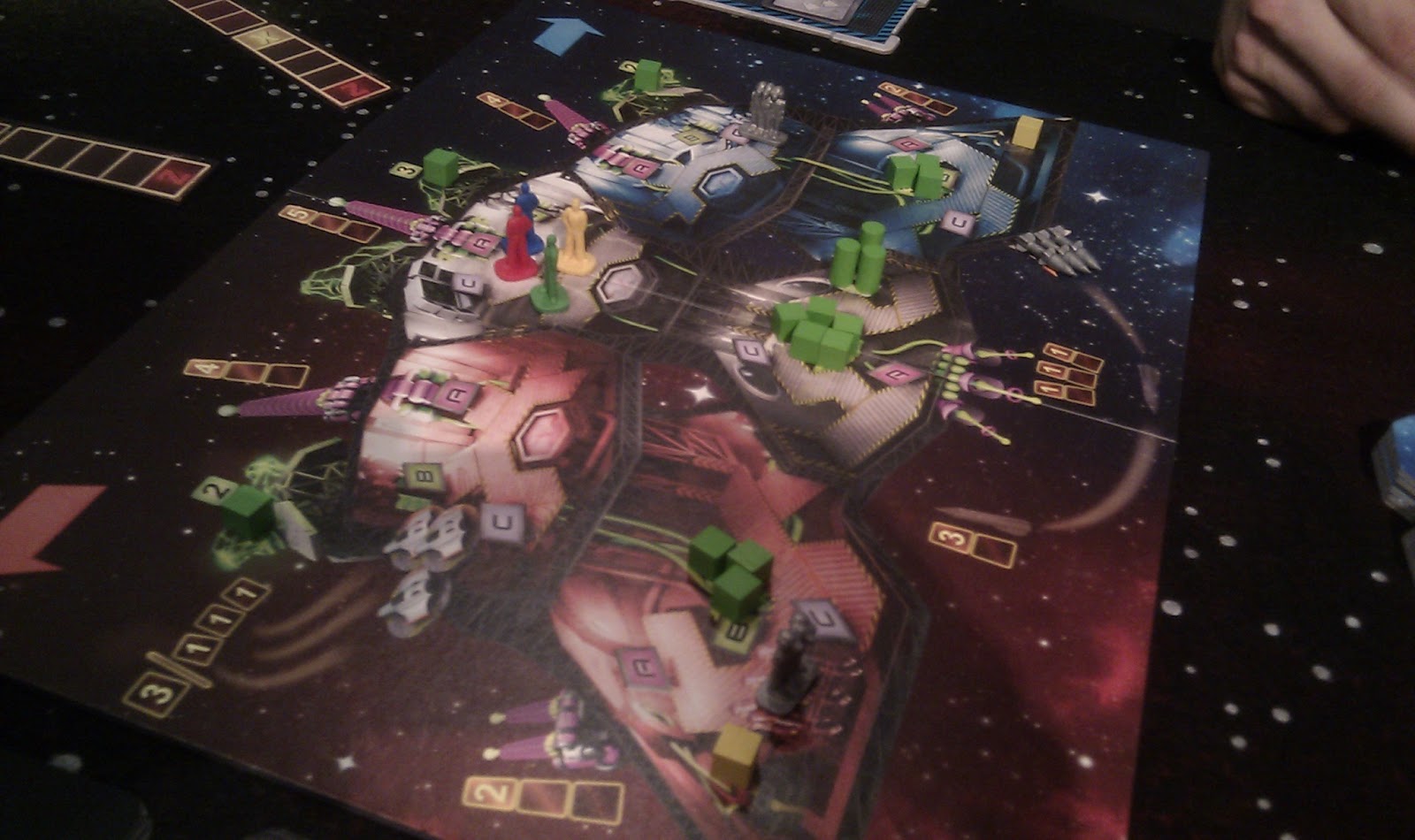
After this it starts to get muddled; Gears of War, Lords of Waterdeep and Runewars have been played to an equal amount. As have High Frontier which I'm really happy about! It has met with some resistance in my group but I think a couple of them are starting to see the light. Anyway, we've also played some Arkham Horror, Twilight Imperium and A Game of Thrones... among others. I'm sad to say that last year's most played board game, Earth Reborn, haven't had single play in 2012! Need to remedy that.

Roleplaying Games


2012 has not been a good year for roleplaying I'm sad to say. During the first half of the year it was me who was tired of always having to GM and during the second half as I felt a bit more energized my group proved resistant, seeming more interested in simple board gaming. We did manage to squeeze in a session each of Fiasco, Diaspora and recently the demo adventure for Only War, but it's not nearly as much as I would have liked.

To be honest I'm not sure how to remedy this situation. I've said before that the best solution would probably for me to find a new group to play roleplaying games with, but this is a tricky thing as I'd like to play with people similar to myself rather than the usual suspects at the local games store. I'm going to see if we can get The One Ring or some other cool game going but I don't have high hopes. :(

Miniature Games

Rebels raiding an Imperial convoy for supplies.

Well, 2012 haven't been the year of roleplaying but it has been the year of miniature gaming! Star Wars: X-Wing manages to just barely snag the top position as not only the most played miniature game but the most played game of the year! While we experienced a break from the game during the autumn the Kessel Run event helped push the plays up. I'm having a great time with the game and it just becomes more fun as you start learning how to maneuvere better and the importance of formation flying. Certainly a game I'm looking forward to seeing more of during 2013.

Just a single play behind X-Wing is of course Dust Warfare. It was finally released in May last year and we had fun playing the initial battles where I was loaning models from Anders. It was with the release of Campaign Book: Zverograd and the new SSU faction that I really started to enjoy it though. I think the Russians are a lot of fun to play as and their style suits me well. While they have been missing some troop types, limiting their tactical options, these have recently hit the street in the form of Campaign Book: Hades. This latest book also includes a simple, yet fun looking campaign system that I think we'll start to try out during the coming months.

Finally we have Infinity which have slipped down a couple of places since last year. The reason is two-fold: X-Wing and Dust Warfare have taken most of my miniature gaming/painting time and I have been waiting for the Paradiso campaign book. Of course, the book is out now and I'm feeling the urge to get into some serious tactical action rising! There are certainly more models that I want to paint for my Yu Jing, but I'm seriously considering getting myself some mercs heavy Qapu Khalqi as a second faction.

I've also tried Task Force Zeta and Judge Dredd the Miniature Game - two games that I really enjoyed and would like to play more of in the coming year. The 1.1 version should also be making its' way to me courtesy of Robin Fitton so I see some 15mm gaming in the not too distant future as well.


So there we have it, a quick rundown of my gaming 2012. I have to say that my favourite gaming purchase as well as gaming experience is Phil Eklund's High Frontier! While it's not my most played game it's just such a different experience from anything else I've played! It's a game that demands a little more from the player in form of pre-planning and coming to terms with the very open sandbox play style, but once you get it the reward is great. You can read my two session reports right here on the blog: Going For the Asteroids in High Frontier and Going Interplanetary in High Frontier.

I'm eagerly looking forward to the next expansion and also picked up another Sierra Madre game, Bios: Megafauna, that I'm hoping to try out soon.

Well, that's the first part done! Next up will be the ...and Future part where I'm looking forwards at the year to come. Happy 2013 everyone!
7 comments