firebroadside@gmail.com
Showing posts with label High Frontier. Show all posts

Friday, 22 November 2013

Review of High Frontier and Colonization

High Frontier: Colonization setup
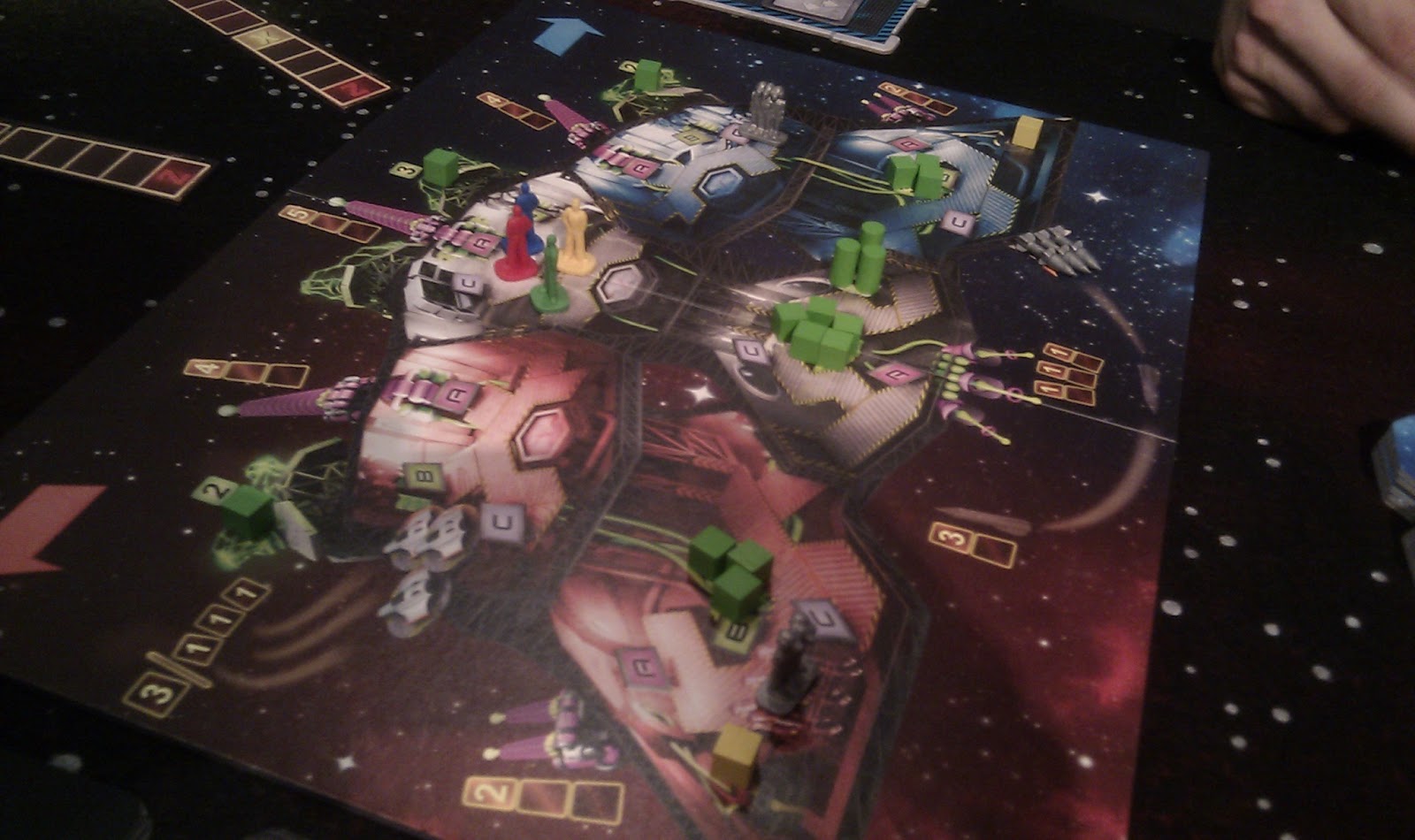
A few turns into a game of High Frontier: Colonization
Phil Eklund's High Frontier has made regular appearances on this blog since I first got it back in mid 2012 but, although I wrote a couple of meaty play reports (here and here), I have yet to actually review it. With the release of the new Colonization expansion that I have now hade the pleasure of playing twice I thought I'd kill two birds with one stone and review both the base game and the expansion.

However... that's not really accurate. The base game is a bit of a misnomer as it's more of a tutorial game to get you to understand the fundamentals, but it's not the way High Frontier is meant to be played in the long run. In fact, unless I was teaching the game fresh to someone I really couldn't see myself going back to that version of the game after having experience the full glory of a complete game of High Frontier! Even so, let's take a look at what High Frontier is and how it's played.

The game is written by Phil Eklund of Sierra Madre Games who is famous in the board gaming world for his very particular approach to board gaming and rulebook writing. High Frontier is the spiritual successor of his earlier space flight game Rocket Flight from 1999. Phil is a bonafida rocket scientist and judging from Bios: Megafauna and Bios: Genesis (fingers crossed!) he seems to be well versed in biology/zoology as well. In short, a man of science! This is something that certainly shows in all his games - both in the integration of theme and game mechanics as well as how often a large part of the rulebook is given to explain the science and/or history underlying the game.

At first glance High Frontier might look like a game about spaceship design and spaceflight. But while those are two of the elements of the game it is really more about exo-globalization - the industrialization of the solar system and (in Colonization) the future of mankind. How you go about this is very much up to you as there are many ways to succeed within the framework of the game. In other terms, this is a sandbox game that gives you access to a bunch of rocket parts and then lets you loose in the solar system!

The Tutorial Game

As I said above what is called the base game is really only a tutorial to make you into a steely-eyed missile man ready for the full glorious potential of High Frontier Colonization! Still, it's a good starting point in talking about how the game works and what you do while playing. But first, let's talk a little bit about the beautiful map of the solar system that forms the game board.

High Frontier solar sail play
PRC are using a solar sail and make several quick, cheap trips to get all the needed equipment to its destination. As you can see on the playmat the rocket's tanks are empty. Solar sails don't need propellant!
There are no squares to put your rockets and cubes in. Not even hexagons! Instead we have many intersecting lines that all represent... well, let me quote Phil:
The High Frontier map divides space into two topographies: circumplanetary burns (steep gravity wells around planets), and interplanetary Hohmanns (shallow heliocentric gravity fields). It scales to energy, not distance! Note that each spot represents a stable orbit, so rockets do not "drift". To change orbits, you must achieve a "velocity increment" that costs mass and energy. 
-High Frontier rulebook, page 1. 
So basically you move along the lines of the map and whenever you enter a pink circle you need to do a Burn which uses propellant. The number of Burns you can make and how much propellant is used each time is dependent on the thruster you are using and the mass of the rocket. More mass=more energy required to move=more propellant used. It all comes together on the player mat where you track your rocket's mass and how much propellant is in its tanks. There are other kinds of circles as well, sometimes containing different hazards, that are risky to enter. Where two lines intersect is also a space where your rocket can thrust into a new trajectory at a cost of either more propellant or more time. Alright, so with that out of the way let's continue with the rest of the game.

There are five different playable factions in the game; NASA, ESA, UN, PRC and the Shimizu Corporation. They have some different abilities like the UN getting money when anyone prospects or industrializes a site or ESA who can boost a rockets thrust by one, thanks to their laser powersats. Each also have a crew card that can be used for prospecting and some other stuff. What you first need to do when the game starts is get a rocket going as that is the main way of getting around the solar system. The game ends when there's a set number of factories built (usually two per player) at which time you calculate victory points that you get from how much you've been able to industrialize, from glory missions (like being the first to get your crew to Mars and back) and from "Space Ventures". At it's very core this is a (space) racing game.

In the base game there are only three kinds of parts, or patents, available through research. Thrustersrobonauts and refineries. You need thrusters to go anywhere (although some robonauts also have thrusters), you need robonauts for serious prospecting (they're much better than your crew) and you need a refinery to turn your prospected claim into an industrialized site (a site being anything from a small asteroid to the majestic plains of Mars). Researching in the game takes the form of an auction for the different patent cards and the one who bids the highest gets the card in question. Of course, currency in this game takes the form of Water Tanks that are used both in auctions as well as for refuelling your rocket and boosting stuff into orbit. Anyway, just slapping everything together and heading for the stars is usually not a good idea as that creates a rocket with very high mass that takes lots of propellant to get moving. If you have managed to find a thruster with very low fuel consumption, like the Metastable Helium thruster pictured right you might be able to do it, but even then you'll have to plan your expedition well.

High Frontier ESA VASIMR
ESA is running a more traditional rocket using the VASIMR thruster.
Don't worry about the generator and reactor... we'll get to those later.
Most of the time you start by going out just with a thruster and a robonaut to prospect some promising sites that you've had your eye on. This is not an automatic process and depending on the robonaut you are using there are many sites you simply can't try to prospect, and others that might be too small to chance it. Once you've got an interesting prospect or two claimed you leave your robonaut there, and start working on getting a refinery to the site in question as both are required for industrialization. If you have enough propellant left, or if refuelling in situ is an option you could go back and pick up the refinery. You could also decommission your thruster and simply boost a new one together with your refinery. Costly perhaps, but you might save time in the long run and don't forget that this is a race!

You also need to keep in mind the spectral type of the site as this decides which of your patents you can upgrade and make better versions of in your space factory. If you've industrialized a stony (S) site you can do a production action and flip one of your S cards over to its black side, which will give you a more powerful/effective thruster, a better robonaut or a refinery with some special benefits. So as you prospect more sites and build more space factories you can slowly upgrade your rocket with black cards that allow you to reach further and accomplish more!

As you industrialize a site you can also construct a simple "tea kettle" freighter that can hold one card in its hold and move one burn per turn, freeing up your rocket to do the heroic stuff instead of simply shipping parts around. This helps with logistics as you need to move one black part from a factory to where you're rocket is going, or back to Earth to sell.

High Frontier
More sites are being prospected and industralized.
Then as the fourth or sixth or seventh factory is built the game ends and you tally up your points. This might seem a little anti-climactic but remember that this is the tutorial game only, and all the really great stuff is coming later. Still the first few times you play this is more than enough to boggle your mind. Player interaction in the base game is usually limited to indirect action like buying patent cards your opponent dearly crave, prospect a site before your opponent get there or brokering deals for patents or assistance during the game. There is no direct confrontation possible, although the PCR can "claim jump" and steal other players prospect claims!

It's worth mentioning that the play reports I linked to above were played only using the tutorial rules. Now let's have a look at the full game.

The Full Game

Actually, it's called the advanced game, but that sounds misleading. This is simply the full version of the game and how it is meant to be played. Now we're getting into expansion territory, so let's talk a little bit about that first. At the same time the basic game was released in 2010 an expansion containing the parts needed to play the full game was released - some more cards and a second game board that extended the play area to include Jupiter and Saturn, as well as containing information about events and space politics. This is the original "Advanced Game".

However, it has been out of print for quite a while now and the new Colonization expansion contains everything from the original expansion plus some additional stuff that makes it even cooler, so this is the version I will be covering. For all intents and purposes I will continue writing the review as if the original expansion didn't exist in the first place. Just for simplicity's sake.

High Frontier cards and playmat
The eight different patent and colonists cards as well as the VP board, Sunspot cycle and Polity tracker. 
In the full game quite a few new concepts are introduced. Some of them core to the entire experience and some in a modular format that allows you to pick and choose which you want to play with (although, I personally wouldn't play without all of them). The core elements are the addition of three more patent support cards: reactors, generators and radiators. In the full game many of the thrusters, robonauts and refineries require support cards to run. A thruster might require an electric generator or a burst plasma reactor with two therms of cooling provided by radiators! So instead of just picking your favourite thruster and robonaut and get going you need to make sure they are powered and have enough cooling.

This is an entire game in itself as you want to build as efficiantly as possible. Having a thruster that needs a pulsed generator while your robonaut needs an electric generator might not be a good combination for example. If they both use the same generator you just need to bring one along to power both parts. So you'll spend a lot more time cajiggering with your rocket than in the base game. On one hand it's trickier, on the other you have a lot more options for making cool combinations and making thrusters that rarely get used in the base game actually workable thanks to efficient support cards. Getting a half-decent rocket together is one of my favourite parts of High Frontier and it's a great feeling when you manage to get something together that will actually get you where you need to go!

PRC has constructed a better solar sail, a nanobot robonaut and a lighter refinery using his space factories. For further exploitation of the Solar system! His promoted Bernal is still in its start orbit at Earth-Luna L3 with the Botany Bay convicts on board.
You will also need to keep an eye on the rad-hardness of your parts. Flying through radiation belts (like the one surrounding Earth!) can be risky if your parts aren't well shielded or if you're going slowly. And even if you pass through all right there's the ever present risk of a freak Solar flare or coronal mass-ejection which can fry your electronics. So keep the rad-hardness in mind. Especially if flying during the Red Sector.

Red Sector?! What the hell is that! Yepp, another core element of the full game is the Sunspot Cycle. It consists of twelve spots in a ring and every time the first player takes his turn you move a marker to the next spot in the ring. It is divided into three different cycles which can have different effects (red=solar flares, blue=election year, yellow=budget cuts) and every other spot comes with an event that you need to roll for. An event affects all players and can be anything from glitches in your rocket to pad explosions to government elections. There are ways to protect yourself from many of these things but you need to plan for them nevertheless.

During an election all the players make a bid and the highest player gets to move the polity marker one space. This can have different effects depending on where it moves and if it moves into the spot of a certain faction, say PRC's Press Gangs, it will be worth VPs at the end of the game. The marker can also be moved into anarchy and war. And yes, during war you can attack other players rockets and factories, using your robonauts and thrusters (as missiles)! I have yet to actually see any combat in the game, but it's a very real danger.

Besides these core concepts Colonization also introduces four new card modules: Freighters, Bernals, Colonists and Gigawatt Thrusters, and a new endgame module. So let's take a quick look at each of these.

  • Freighters. Using this module you don't automatically build a freighter when industrializing. Instead it is patent card that you need to research and then build at one of your factories. There are five different freighters with different capabilities. They have different movement and different sized hold. They can also be promoted to their purple side, making them more effective and providing a Future (more on this later). 
  • Bernals. A Bernal Sphere is gigantic space habitat in the vein of the O'neill Cylinder or the Stanford Torus and if you play with this module each player has a Bernal in a starting orbit near Earth. It functions kind of like a second rocket, except it's very heavy and slow to move around. If you promote it, by giving it a generator, it flips to its purple side and it can then move by itself as well as provide some special abilities. If it's placed adjacent to one or more of your industrialized sites it's said to have these sites as dirtsides, meaning you can produce directly to the Bernal. Basically it becomes your base away from low Earth orbit.
  • Colonists. There's a deck of colonist cards that you can recruit. Each of them functions pretty much like your original crew card, except they all have special abilities and some of them have built in reactors or generators. Bust most importantly, the provide you with extra actions during your turn! They also provide votes that are added to the players bids during an election (voting for the faction they areactually loyal to, which may or may not be the faction you're playing) and all of them can be promoted to their purple side, with some of them providing Futures. There are also some Robot Colonists that need to be built at a factory. They work a little differently and can't vote unless someone has performed the Suffrage Operation to give basic human rights to them, in which case they always vote for their Emancipator (awesome, right?!).
  • Gigawatt Thrusters. These are similar to your regular megawatt thrusters from the base game except they need to be built at a factory and they are stingy with their propellant - if it's an S GW Thruster it can only refuel at an S site. However they are very powerful and with one of these babies you can seriously start considering going beyond Saturn towards Uranus and Nepune. They can also be upgraded to their purple, Terawatt Thruster, side which is even more powerul and which also provides a Future.
  • Endgame Module. I've talked a lot about promoting and Futures. What is that? Well, all these four card modules really come together in the Endgame Module and this is why I feel it would be weird only playing with Bernals or only Colonists. You can promote a card by building a Lab and taking the card there. A Lab is any industrialized site at a trans-Neptunian science site... and they are pretty hard to get to. Your Bernal also becomes a Lab if it has a dirtside at any science site, which is normally easier to achieve. 
Many promoted cards provide Futures, and this is the new endgame condition of the game. In a two player game the game ends after the first Future is achieved or attempted. In a three player game it's after the second Future, and so on. So wha tis a Future? It is basically some neat sci-fi idea that you need to accomplish to show that humanity is carving its mark on the universe. Perhaps you need to build aerostat factories on both Saturn and Uranus, or maybe you need to try and create a mini black hole with one of your scientists, or it could be that you want to strap a Gigawatt Thruster to a comet and crash it into the Earth (ending the game with a bang!). If you succeed at a Future you get some VPs and the game is one step closer to ending.

And... that's about it. Sorry for getting a bit rules heavy there at the end, but I felt it was needed to get the scope across. Right now it might seem like all these things would be impossible to remember and keep separated in your head during play, but if you start out with the tutorial game and wrap your head around rocket flight 101 you shouldn't have any problem graduating to the full game!

Both ESA and PRC have managed to create labs at their Bernals as their dirtsides (at comet Elst-Pizarro and the subsurface ocean of Callisto, respectively) are Science sites. Some cards have been promoted already, like ESA's Frankenstein Navigators at bottom right. Now it's time to start looking at available Futures!
It's might be worth mentioning here that Phil has also constructed High Frontier: Interstellar which is a print-and-play sequal to Colonization where you use the resources you created there to move around the stars in generation ships. You could also start from the beginning with Bios: Megafauna, use the creatures you create there as the basis for your culture in Origins: How We Became Human, use the end of that game as the starting foundation to High Frontier and finally play Interstallar. Pretty neat!

My Thoughts

So with the workings of the game figured out what do I actually think of it. Short answer: High Frontier is my favourite board game. Full stop.

Long answer: High Frontier was a real eye-opener for me as a board gamer, or gamer in general. I've always been a fan of a strong theme in games and in the past that is why used to found myself oogling the stuff FFG et al with all the mountains of plastic and bright shiny cards. The word theme gets bandied about a lot and for many, including myself a few years ago, theme means just that - nice components. I've played most of FFG's games at one time or another, and I do like some nice components but a true thematic experience comes through the integration between theme and mechanics and there is often a disconnect there. That doesn't have to be a bad thing necessarily. Lords of Waterdeep is still a good game, even though the theme is just a thin veneer. And no matter how great looking the room tiles and miniatures are for Mansions of Madness it's a long way from actually sneaking through a haunted house.

ESA succeed in moving the Polity marker to the left, away from war and anarchy.
So where am I going with this? I think I said it in my firt impressions-article on Bios: Megafauna, and that is that when Phil makes a game he does it with the approach of a simulationist - as in 'how could I realistically portray function X in board game terms? Like, how do I simulate realistic rocket flight on a game board?'. In a game like Firefly, that has no aspirations to scientific realism, you simply move a number of spaces and draw some cards. In High Frontier all the trajectories, burn circles and Hohmann intersections are calculated correctly as well as thrust, fuel consumption, radiation strength etc and then the game is extrapolated from that. Again, let me quote from the Game Scale section of the rulebook:

  • A thrust of one is 0.75 kN (750 newtons, or 169lbs, the weight of the game designer on Earth!). Each additional point doubles this.
  • An acceleration of one is 0.38 milligees or 0.38 cm/sec², and each step more doubles this.
  • A size one world has a surface gravity of 0.75 milligees, and each additional step doubles this. Size 1 worlds have the following diameters based on density: comet nucleus 52 km (only Centaur comets approach this size), S-type asteroid 22 km, M-type asteroid 14 km.
  • Beamed power emits a 60 MW laser beam. Generators produce 60 MWe of electricity. Reactors produce from 650-2000 MWth of thermal energy, either in neutrons, pions, or plasma jets. Each therm radiates 120 MWth of heat. (Subscript e = electricity, th = thermal).
  • Each burn requires a delta-v (velocity change) of 2.5 km/sec. Each brachistochrone is 5.0 km/sec.
  • A solar flare die roll of 1 is an M1 flare with an X-ray power density of 10^-5 Watts/m². Each point more is 4 times this. Thus, a die roll of 6 is a X95 (Carrington-class) flare with a power density of 10^-2 Watts/m².
-High Frontier rulebook, page 13.

This might look scary to the casual observer, but remember that this is all under the hood calculations that have been wrested into a (relatively) easy to understand board game. It's just a great feeling to play the game and know that all the underpinnings are not simply numbers crunched to fit the game, but actual "real" numbers that the game has been wrapped around. And this design principle goes through the entire game, and all the other Sierra-Madre games I've played!

What this means is that the theme and mechanics of the game are so deeply integrated with eachother as to be virtually unseparable. For example, there is simply no way of re-theming High Frontier into anything other than a game about rocket flight and space industrialization, and the same thing goes for Bios: Megafauna. You might change the map around and give the parts different names perhaps, but you wouldn't be able to turn it from a game about rockets to a game about cooking food (something which can't be said of Lords of Waterdeep for example).

To win (or at least end the game) PRC need to create some antimatter! They can do this by using a promoted engineer at a factory on a science site and succeed with an "Epic Hazard Op" - meaning they need to roll anything but a 1 on a die.
Ok, so I've taken a long time to say that the theme is a core part of the game and not simply an afterthought. Great. But what about the game? Is it fun? That is the other thing. Not only is the theme well executed but the mechanics work not only as a simulation but as an actual competetive board game. Yes, I'll be the first to admit that I was a bit daunted when I first started reading the rulebook, but that is more about me not being familiar with this style of writing rather than it being a bad rulebook. The first time you go through it nothing will seem to make sense at the start, but by the time you finish it it has all become clear. Then read it again with your new eyes and you will discover how clever the design is. 

While FFG might make rulebooks that are better at introducing the game they are rubbish as reference tools. Sierra-Madre rulebooks on the other hand can be tricky to read the first time through, but then work great while you are actually playing and need to look up a particular rule or two. Especially with the new Alive and Complete version of the rulebook available for download.

I'm a big space exploration and rocket enthusiast so naturally High Frontier would appeal to me. The game might be a hard sell to players who are not as interested, but the actual game is meaty enough to get anyone hooked if they can just get past the inital learning hump. Most people will struggle with basic rocket movement for their first few turns, or their first game, but once it clicks you start looking at that map with whole different eyes!

At the same time ESA is racing to get their scientist to their Bernal where they would be able to score a Future! They're currently in low Earth orbit though. Will they make it?!
The tutorial game is a sandbox and this too can be daunting because there is no hand-holding involved. Nothing telling you exactly what to do or where to go. You need to decide what mission to undertake yourself, based on the patent cards in your hand. It requires planning and patience and going off half-cocked is usually a good way of stranding your crew. Still, the base game is limited in time. Usually, by the time you start getting to the really good stuff, like factory produced thrusters and robonauts the game is about to end. You rarely get to play with your new toys more than a dozen turns or so.

The full game changes all of this. If the tutorial game is a sandbox this is a desert! The sunspot cycle with its events and the polity tracker plays a large role in how the game will evolve and using the support cards means that you will see a lot more different rockets being used. These core concepts alone takes the game to the next level, but then adding Colonists and Bernals etc really helps making the game epic! These modules also help to make the game world feel more alive and as you play you can't help but make little stories in your head. While the tutorial game can be a little clinical in its execution the full expansion experience is gritty reality! You can really feel those Attican Secessionists who want to declare independance from Earth or your Bernal hauling new technology from its dirtside factories. It makes not only for a great gaming experience, but for a great storytelling experience as well!

PRC is quicker to get their Future and the game end shortly after. Counting the victory points it's a close race, but the PRC come out the winner, thanks to the 12 points for completing the firt Future!
The politics and deal-making of the game is also something to be mentioned. The first few times you play you'll usually be too busy making sure your rocket isn't exploding to really pay detailed attention to what the other factions are up to. But as you progress in the game and learn more about the different patents and good paths through the Solar system political and economical maneuverings will start taking place. Buying and withholding  a patent card critical to an opponent suddenly becomes an effective tactic (especially if you play the Shimizu corp.). You can make all kinds of deal throughout the game, like paying for an extra boost from ESA or trade patents.

The Political tracker might seem like a quaint detail mostly centred on theme at first, but getting the Polity disc into one of the spots providing special rules, like only allowing NASA to initiatie research, or banning any and all reactors can have quite an impact on the game. Not to mention anarchy and war - whenever the political climate turn into anarchy every player starts to eye the board for chances of stealing other factions claims!

The game usually starts out slowly with everyone getting their bearings and start working out plans on where to go and how to get there. During the mid-phase there might be some struggle for patent cards and sites to prospect and during the last phase it's all about getting your lab up and running to be able to promote cards to get some Futures available. It's more of a marathon than a sprint, but High Frontier is certainly a race!

I mentioned it at the start: this is my favourite board game, and I've tried to convey why in this article. It is tough to get into, the rulebook and the graphical design of the game might look odd to you the first time you encounter it, but if you persevere and actually learn the game you will be richly rewarded both in regards to a thematic, immersive experience as well as a tight racing game focusing on resources and maneuvers.

I really can't recommend the game enough, and it only gets better with Colonization. Get it!

4 comments

Wednesday, 2 January 2013

Past...

It's that time of the year, or rather it was that time of the year last year, and everyone else is doing it so here's my look at the past year of gaming and what the future might hold. However I've decided to split my usual Past and Future post into two to be able to go into a little bit more detail. Here's what I've been playing during the past year.

Board Games
Peekaboo!

Not surprisingly Descent: Journeys in the Dark Second Edition was my top played board game. We started playing the campaign in August and almost finished it, but then took a long break until December to actually finish it. We had a great time with the new rules and the lenght of the campaign felt just right. I have ordered the expansion and next time Micke has promised to pick up the Overlord mantle. Looking forward to it!

Second on the list (same as last year!) is The Lord of the Rings: The Card Game. I've come to the conclusion that this game is not all that fun when you are four players. It's simply too easy and quickly becomes uninteresting. However, it shines with two and three players and now that I have the complete Mirkwood cycle of cards I've started dabbling in proper deck building which is fun. Writing about it now makes me want to bring it out to play actually.

This might come as a bit of a surprise, but my third most played board game of 2012 is actually Space Alert! It was back in April/May when we kind of re-discovered it with a new group of players. We played it a bunch of times, but often had to start from the beginning to allow new players to learn the rules. We still haven't got to internal threats or using the fighters. :(

After this it starts to get muddled; Gears of War, Lords of Waterdeep and Runewars have been played to an equal amount. As have High Frontier which I'm really happy about! It has met with some resistance in my group but I think a couple of them are starting to see the light. Anyway, we've also played some Arkham Horror, Twilight Imperium and A Game of Thrones... among others. I'm sad to say that last year's most played board game, Earth Reborn, haven't had single play in 2012! Need to remedy that.

Roleplaying Games


2012 has not been a good year for roleplaying I'm sad to say. During the first half of the year it was me who was tired of always having to GM and during the second half as I felt a bit more energized my group proved resistant, seeming more interested in simple board gaming. We did manage to squeeze in a session each of Fiasco, Diaspora and recently the demo adventure for Only War, but it's not nearly as much as I would have liked.

To be honest I'm not sure how to remedy this situation. I've said before that the best solution would probably for me to find a new group to play roleplaying games with, but this is a tricky thing as I'd like to play with people similar to myself rather than the usual suspects at the local games store. I'm going to see if we can get The One Ring or some other cool game going but I don't have high hopes. :(

Miniature Games

Rebels raiding an Imperial convoy for supplies.

Well, 2012 haven't been the year of roleplaying but it has been the year of miniature gaming! Star Wars: X-Wing manages to just barely snag the top position as not only the most played miniature game but the most played game of the year! While we experienced a break from the game during the autumn the Kessel Run event helped push the plays up. I'm having a great time with the game and it just becomes more fun as you start learning how to maneuvere better and the importance of formation flying. Certainly a game I'm looking forward to seeing more of during 2013.

Just a single play behind X-Wing is of course Dust Warfare. It was finally released in May last year and we had fun playing the initial battles where I was loaning models from Anders. It was with the release of Campaign Book: Zverograd and the new SSU faction that I really started to enjoy it though. I think the Russians are a lot of fun to play as and their style suits me well. While they have been missing some troop types, limiting their tactical options, these have recently hit the street in the form of Campaign Book: Hades. This latest book also includes a simple, yet fun looking campaign system that I think we'll start to try out during the coming months.

Finally we have Infinity which have slipped down a couple of places since last year. The reason is two-fold: X-Wing and Dust Warfare have taken most of my miniature gaming/painting time and I have been waiting for the Paradiso campaign book. Of course, the book is out now and I'm feeling the urge to get into some serious tactical action rising! There are certainly more models that I want to paint for my Yu Jing, but I'm seriously considering getting myself some mercs heavy Qapu Khalqi as a second faction.

I've also tried Task Force Zeta and Judge Dredd the Miniature Game - two games that I really enjoyed and would like to play more of in the coming year. The 1.1 version should also be making its' way to me courtesy of Robin Fitton so I see some 15mm gaming in the not too distant future as well.


So there we have it, a quick rundown of my gaming 2012. I have to say that my favourite gaming purchase as well as gaming experience is Phil Eklund's High Frontier! While it's not my most played game it's just such a different experience from anything else I've played! It's a game that demands a little more from the player in form of pre-planning and coming to terms with the very open sandbox play style, but once you get it the reward is great. You can read my two session reports right here on the blog: Going For the Asteroids in High Frontier and Going Interplanetary in High Frontier.

I'm eagerly looking forward to the next expansion and also picked up another Sierra Madre game, Bios: Megafauna, that I'm hoping to try out soon.

Well, that's the first part done! Next up will be the ...and Future part where I'm looking forwards at the year to come. Happy 2013 everyone!
7 comments

Monday, 30 April 2012

Going Interplanetary in High Frontier!


ESA stake their claim on Mars.

We managed to play another game of High Frontier this past weekend. I was actually only aiming for a trial/tutorial game to showcase it, but in the end we played it the entire way through. I simply didn't want to end it until the game had started clicking for my new players, and this took quite a while...

Our second foray into the solar system was made with four players. Myself playing the People's Republic of China (PRC), Anders as ESA, Claes as the UN and Micke as NASA. It was a new game for Claes and Micke so after a 30 minute rules explanation we began.

Well... you know what the board looks like by now.

Just like last time the first hour of the game went slowly as we all tried to get the patents we wanted. I made a quick mission to asteroid Eureka for the glory points and a few turns later Anders set out for the moon. However he hadn't thought it through entirely so although he managed to land, claim it and take off again the crew found themselves without enough fuel to get back to Earth! Stranded in Lunar orbit the ESA command staff decided to turn the rocket into an outpost (basically leaving the crew and the rocket engine floating in space) while he worked on a new rocket that could be used for a rescue mission.

ESA's claim on the moon (left disc), the outpost in orbit (right disc) 
and the rescue rocket being assembled in low Earth orbit.)

Micke as NASA had put together a rocket complete with robonaut and refinery but had trouble with its high mass. The engine he was using had a fuel efficiency of two so he was worried that he wouldn't be able to get anywhere. This is an illusion that is easy to fall prey to when you start playing High Frontier. You calculate your available burns (in Micke's case five I think), then you look at the huge sprawling map of the solar system and you feel like there's no way you'll be able to go anywhere worthwhile! After talking him through it and showing him some available routes though, he realised that he could actually make his way to the Gefion family of asteroids, and Ceres in particular. Sure he'd be bingo fuel at that point, but that would hopefully not be an issue as he was going to build a factory there anyway which would let him refuel quickly. For some reason or other Micke still decided to play it safe (this is space travel after all!) and left his refinery in low earth orbit to be picked up later as he went prospecting with only his crew and robonauts.

The UN building their first ET factory on Hertha.

I had my second mission on the way as well. I had procured a raygun robonaut with an ISRU of 2 (lower is better) which opened up a whole slew of asteroids to me. So I aimed to do basically the same thing as last time and set my  goal at the Koronis family of asteroids. By this time Claes had finally got his mission off the ground and headed towards the Nysa asteroid family. He claimed Hertha and built a factory there but his UN crew weren't quite up to the task of prospecting Nysa itself even with the help of his new hi-tech refinery and a re-roll for using a buggy. The Chinese rocket had just reached the sweet spot in the Koronis family and proceeded to prospect five asteroids in one go! Unfortunately I didn't have much luck with the die and only managed to claim a single one. It allowed me to build a factory there and upgrade my robonauts to a respectable ISRU 0 raygun! I had the option of developing the monstruous Salt-Water Zubrin thruster instead, but I had an engine that could so the job decently so opted for the robonauts as they felt more important at this point in the game.

PRC (red) heading towards the Koronis family while NASA and ESA are back in LEO.

During all this time (10+ years in game time) Anders simply tried to scrape together enough money to boost the parts he needed for his rescue mission.

By the time NASA had returned to pick up his refinery and fly it back to Ceres I had just returned to LEO where I sold my new fancy hi-tech robonaut for a hefty sum (knowing I could always build more at my asteroid base) and started looking around for a second refinery so I could build that big nasty engine!! Micke got his factory at last, very happy that he could now finally use a much better thruster he noticed that he'd been looking at the wrong asteroid and had thought it was an S(tony) spectral type when in fact it was a C(arbonaceous). Quite a setback when much of his plans had been riding on the new tech.

ESA finally rescued their stranded crew thanks to their new solar sail and Anders started prepping for a new mission... sunwards. He'd been the first on the moon and now his next target was Venus! The solar sail is an interesting thruster as it doesn't use any fuel but it also has a very low thrust. However, the closer you get to the sun the more bonus thrust the sail gains so when nearing Venus and Mercury the ESA spacecraft was zipping along very quickly. There were a couple of sweaty minutes as Anders rolled for the aerobreaking (roll a 1 and your carefully assembled spacecraft becomes so much spacedust!), but he made it successfully and his crew became the first humans on Venus! They were later told that they were the first settlers as well, as their solar sail had been lost during the aerobreak and they had no thruster strong enough to get out of Venus' gravity well. Time for another rescue mission!

ESA, first mission to Venus!

He did make up for this by quickly launching a robotic mission to Mars as well and building a factory there. This was the sixth one with the seventh ending the game. Micke had built his first and Claes had started scouting for a good location for his third among the Jupiter trojans while trying to claim three M-class sites. I managed to plonk my second down before he managed though and the game ended.

The final score was 24 to me (PRC), 16 to Anders (ESA), 14 to Claes (UN) and 7 to Micke (NASA). It might seem like I was way ahead but just like last time that is mostly thanks to the glory points by getting the science and any site awards. Without those I would only have had 18 points - much closer!

Looking at the performance of my three friends I think they did well overall, even though it was a long, slow start. Claes was the slowest by far in the beginning, but at the end of the game he made a lot of smart choices and started to understand how an extra-terrestrial factory really opens up your exploration options! Micke took to the rules reasonably quickly, but had trouble grasping what his overall goal should be - get victory points, yes, but how to go about that. There are a lot of interlocking mechanics in High Frontier, and while the rules themselves actually aren't that complex the different interactions between patents, their hi-tech side and spectral type can be fairly dense. Seeing what needs to be done to achieve your industrial and point scoring goals can be a challenge at first. As far as I could tell Anders didn't have any trouble with the rules (although I think perhaps he thought he did), but he suffered from bad mission planning. Getting stuck in lunar orbit waiting for rescue for 10 years and then getting stuck on Venus wasn't part of the mission statement. If he'd planned ahead a little bit more carefully it would have been a much closer race I think.

What they thought of the game when we were done was that it was fun and interesting once it "clicked" but that that click came fairly late in the game. There were many rounds spent on bidding for patents at the beginning. Probably about an hour of only that! I think it's a part of the game that will become much more exciting once we all become more comfortable with the game and understand the different patents, but at this juncture it just felt long winded and kind of dreary. I think next time we will try the quick-start rules where each player get one random patent from each category.

However, there has been one BIG thing we've played wrong in both these games. Namely that we've played rocket movement as an entire turn in itself! This is way off as you're actually able to do an operation and move your rocket each turn. This error alone probably doubled the length of the game! So things will move a bit quicker next time guys, I promise. :)

Micke and Claes both said that they'd like to try it again fairly soon, while the rules are still fresh in their minds. I think they both saw the potential in the game as first Claes started asteroid hopping and then Micke caught on as well. I'm not sure about Anders as he spent a lot of time this game simply trying to salvage half-failed missions. It might be the importance of planning ahead as he's often been a kind of lets-try-this-out-and-see-what-happens-kind of guy, an approach that rarely pays off in High Frontier. Still, in the end he didn't do badly as he came out second overall. Not to mention the bragging rights of being the first to the moon, Venus and Mars!

I had a blast once again, even though the first third of the game was slow. I'm happy I got a couple more friends to try the game and even happier that they enjoyed it in the end. Will definitely try to schedule another game soon. Next time I think I'm going to explore the use of solar sails properly. I feel there's a lot of untapped potential there! We should also bring out the expansion map at least, so Saturn and Jupiter are available as well.

Until next time fellow kosmonauts!
9 comments

Monday, 16 April 2012

Going for the asteroids in High Frontier!

The way I imagine my ET factory on Karin B.

I first came across Sierra Madre Games' High Frontier back during the winter of 2010 and it immediately went on my must-buy list, but I only got it last week. Finally! It was created by Phil Eklund who's a bona fide rocket scientist and it's about the near future exploration of our solar system. Everything is based on real world physics and the first time you calculate your rocket's modified thrust is a feeling of both dread and awe! At its core High Frontier is a racing game: you want to get out there and prospect as soon as possible as well as grabbing the bonus "glory points" for being the first to succesfully return a crew from Mars etc.

At the start of the game you're all bidding for different rocket modules (thrusters, robonauts and refinieries) that you need to explore space. You need to decide if you want to travel light in an attempt to just gather some quick glory points, or if you want to bring a refinery to be able to actually build an extraterrestrial factory base which will allow you to advance your technology level. Then you need to start planning where to go and make sure you're rocket is not too heavy/slow and what to do when you get there.

The game map. Beautiful and terrifying at the same time! Actually this picture includes both the base game (right side) as well as the map from the expanded game (left side), adding Jupiter and Saturn (not to mention politics and space weather).


In our game I played NASA while Anders took control of the UN. We spent quite a few turns just constructing our rockets, almost going through the entire stack of availbale thrusters before we each settled on our respective designs. I think this was an artifact of our inexperience with the game and the fact that there were only two of us. With more players the race aspect would have been much more in focus and shorter flights would probably have been a more attractive goal. As it were we took our time to make rockets that could make it into the asteroid belt, each of us bringing robonauts and refineries.


NASA (white) on their way to Karin while the UN (purple) still linger in low Earth orbit.

I launched my mission one or two years (turns) before Anders and made it to the Karin family of asteroids. Since I had raygun-type robonaut I could prospect a lot of asteroids in one fell swoop, even though I needed to roll 1s and 2s to succeed. My prospecting succeeded on three of the planetoids and I used my refinery and robonauts to build a factory at Karin B. This allowed me to upgrade my raygun robonauts making it a lot more effective at prospecting. My next target was the nearby Vesta family.

In the meantime the UN had launched their expedition to the Gefion family of asteroids, which includes the dwarf planet Ceres. Anders had managed to get his hands on a fairly powerful engine and made it there quickly. He was unlucky and failed at prospecting Minerva, even though he had a re-roll when using his robonaut buggy. Ceres on the other hand is so large that you succeed automatically which was good news for Anders, however he discovered that if he wanted to build a factory there he wouldn't be able to take off as he would have to sacrifice the powerful thrusters of his robonauts. In the end he simply decided to decommision his entire rocked (basically colonising the worldlet) and then start over back in low Earth orbit. This is a perfectly valid strategy although he did miss out on gettin glory points for being the first to return a crew safely to the Earth and he would have to boost his rocket modules into orbit once again.

What it looked like after my initial asteroid prospecting spree! You can see my factory to the left (the cube) and Anders' to the right. The black discs are failed prospects.

While the UN was busy with Ceres I sent my now refinery-less rocket to prospect Vesta and the surrounding asteroids. With the upgraded robonaut and with no refinery my rocket was much lighter and could quickly zip around the belt! After prospecting three more locations (using up the last of my markers) I decided to return to Earth with my crew. This netted me some VPs and I got some more for being the first to prospect three or more S-class (stony) locations. Woo! Instead of boosting more modules for my rocket I simply refueled it and sent it on a quick science mission to Eureka, a Mars trojan asteroid which is easily reachable from Earth. This was simply to get more glory points of course. Next I went back to actually build a factory at Eichsfeldia, one of the asteroids in the Vesta family.

Anders had started construction on his second rocket stack during my asteroid shenanigans and he had his eye on the Nysa family of asteroids as well as the comet Encke. He succeeded in prospecting Polena and Hertha where he also built a factory. This being a two player game the fourth factory signaled the end and we started adding up victory points.

End game. As you can see we went exclusively for the asteroid belt which I think is a valid strategy as you're learning the game. Landing on planets require aero-breaking and crash hazards... scary stuff better reserved for next time. :)

I managed a fairly large victory with 30 points against Anders' 16. This might seem like a crushing defeat, but as far as exploration goes we were fairly even. I had a couple more sites prospected, but what really allowed me to pull ahead were the several firsts that I managed to claim. First to bring a crew back from a site, first to bring a crew back from a science site and the first to claim three S-class sites. Just these three things were worth 11 VPs together so it could easily have gone the other way if he wouldn't have been forced to decomission his rocket at Ceres.

My thoughts on the game: awesome! It might look kind of dry and math-y (and the rulebook reads like something Avalon Hill would've put out during the seventies), but there's a real sense of accomplishment and wonder as you finally launch your rocket towards its distant goal. Sure, I'm a great big space nerd, which helps, but you'd be remiss to discount this game as being only for people like me. There's a solid resource/race game with an economic engine trundling along under the hood. With more players (there's room for five) I can see it becoming both a lot more cut-throat as well as encouraging more trades and dealings between the factions. And I'm looking forward to trying the expanded game where space warfare is an option...

Anders liked it as well, although he felt frustrated that he couldn't practically land on any of the large planets. Or that is what we thought at first at least. After the game we discovered that you can in fact land on the Moon and Mars. You just have to have a very light rocket (a thruster with a crew pod on top) with lots of fuel. So... kind of like the Apollo missions. Then if you want to get serious about it and establish a base there you might need to research some better technology first.

After having had a period filled with lots of wargames (Runewars, Twilight Imperium, A Game of Thrones etc) it was nice playing something different. And High Frontier is certainly different from anything I've played before. To my mind a very cool game with a very cool theme. That it's scientifically correct is just a neat bonus! Don't let the playmat and board daunt you, it's not nearly as complicated as it looks.

I need to play it a few more times, but then I'll put together a proper review.

The UN rocket awaiting refuel in low Earth orbit.
4 comments