firebroadside@gmail.com
Showing posts with label Mouse Guard. Show all posts

Friday, 13 July 2018

A Mouse Guard and Torchbearer Primer


Mouse Guard playing Mouse Guard


Recently I've been listening to the Reckless Dice podcast as they have played a few sessions of Mouse Guard and it reminded me again of how difficult some of the concepts of the game can be. Especially for players used to a more traditional roleplaying format. My immediate thought was to offer some advice about certain things to think about and what stumbling blocks to avoid and share them with the Reckless Dice crew, but I realized that writing something like a primer and share here would probably be more useful for more people (including my own players).

In the following text I will mainly talk about Mouse Guard (or MG), as it is the basis for Torchbearer as well and they are similar in most core aspects. They do differ in some key points though, but instead of inserting those differences in the running text I'll try to collect them at the end in a Torchbearer section. I won't explain the game, as in how the rules work, I'll simply try to give advice on how to interact with those rules and how to play to make the most of them.

I am also aiming this text at players new to the system and who are not really used to these kind of character and narrative focused games. Of course, I hope the advice might be helpful for the rest of you as well. Of course, these are just my personal opinions on the game and how to make it run well, don't take it as Luke's gospel. :)


General Advice

Depending on the system and the players a Session Zero isn't always necessary, but in this case I really think you should try to start off with one. Use it to talk about the setting, the system and to make characters. There's going to be a lot of questions about the unfamiliar parts of the game but since you are all new I don't think it's productive to get bogged down trying to explain all of it in detail. Try to focus on the core of the game.

Do talk about how MG is tighly character focused and although there are quite a bit of rules it is also very narrativistic. In my experience this is the biggest stumbling block for players coming from a traditional rpg background. While we call it ROLEplaying I think many, perhaps most, players tend to end up playing a fantasy version of themselves. I don't mean this in an elitist way where I think this is a bad way of playing - it's not - but it usually doesn't gel with how Mouse Guard was designed.

So let's talk about this. The core of MG are the Beliefs, Instincts, Traits (aka BITs) and Goals. The entire game revolves around these concepts and if they don't click it can grind to a halt (how are you liking those... wheel metaphors, eh?). In traditional games we're used to having rules for physical actions in the game such as swinging a sword or climbing a cliff. Rules for things like persuasion and deceit is very common as well, although such things can also be governed purely through roleplay and GM fiat. What we almost never see are rules for how you should play your character - as in how she would act in certain situations.

In Mouse Guard there are rules for how you should play your character and the system of rewards hinges on you following those rules. This can feel very alien to some players, and paradoxically make it hard for them to know how to act. In the traditional sense of "playing yourself" there's virtually no filter between the players thoughts and actions and the characters thoughts and actions - you often react to what the GM describes the same way you, the player, would react. Having to reroute that process through the BITs of your character can feel cumbersome and be a barrier to what some call "immersion".

What I have found can help players kind of reframe this in their minds is using the director metaphor. Instead of thinking about your character as you, think of her as a character in a tv series you're directing, or a book you're writing. It is still very much your character, but it's easier to get into the habit of thinking about how would she react in this situation, rather than how would react. Once you've shifted to this perspective you'll find yourself looking to your character's Belief and Traits more often to help you decide on how you should proceed.


With this new habit you are ready to really let the characters free. The game sings when you start to discover the story through the characters actions, which are based on their BITs. You should never feel constrained by "the story" or what you think you (the players) should be doing, or what you think the GM has in store for you. Just act on your Belief and the story will burst forth!

This includes not being afraid to go against the other players. If your characters Belief or Goal clashes with another characters, then some PvP might be in order. A passionate argument among friends can be the highlight of the session and the system is built to make this both possible and fun.

Alright, so we've talked about the importance of character and assuming a kind of director stance. What's another great stumbling block? Fear of failure. Through traditional rpgs we've been conditioned to think of failures as the worst possible outcome. We do everything in our might to stack the odds in our favour since failing usually means a null result or a negative result. Sometimes it can even mean the end of the adventure! Mouse Guard flips this all on its head and embraces failure as the catalyst of change and character growth!

When a character fails a roll the GM can either let her succeed anyway, but give her a negative condition, like Angry or Injured, or he can invoke a twist. A twist changes the fiction in some way that propells the story forward. If you're trying to find the path to Sprucetuck but fail, the GM could either let you succeed but say that you are now Thirsty and Hungry from the trek, or he could say that you've actually wandered too far and find yourself in weasel territory. Or it could be something completely unrelated to the actual pathfinding roll, like a sudden thunderstorm or a couple of crows taking interest in the shiny swords of the guardmice.

Twists can often lead to other twists that become adventures in their own right and it is this in combination with the characters' BITs that create the larger story. So failures are fun! They make unexpected things happen and they test the mettle of your character! Additionally they are required to advance your character's skills and abilities - yes, without failing a bunch of rolls you will never get better. Here's an important part where Traits come in, but I'll cover that below.


Stumbling block number three is the GM and Players turn structure and earning Checks. This sounds weirder than it is, but it's pretty much just the regular cycle of most roleplaying games as you move from action scenes to downtime and then back to the action again. The big difference here is Checks, which you must try to collect during the GM's turn to be able to do stuff during the Players' turn. The tricky part about Checks is connected to fear of failure that I mentioned above - to get them you have to affect your character negatively through her Traits. This also ties into the fact that you have to fail to advance your skills, so you now have two big fat rewards for failing!

The Player turn usually comes naturally once the patroll is out of immediate danger and have at least a few checks between them. It might read as very structured and constrained, but I've found that it simply comes organically through the story. If the guardmice have managed to persevere through what you threw at them and find themselves in a natural lull where they're safe from harm, a player turn is probably in order. The suggested two obstacles during the GM's turn is a good benchmark, but more likely than not those will have grown in different directions thanks to twists during play.

Ok, I think that covers the big concepts and themes that are unfamiliar. Let's talk about more concrete actual play advice, bullet point style.

Player Advice

  • Belief, Instinct, Traits, Goal. Keep going back to those and you shouldn't have much trouble.
  • Your Belief might be the most important part of your Character, so give it some thought.
  • Also, don't be afraid to change your Belief it you find that it doesn't come into play, or your character has changed.
  • Is the test practically impossible? Use a Trait against you and throw the test! That's like a free Check and a fail for advancement all in one.
  • Think of the GM's turn as your character being on the job, and the Players' turn as leisure time to recover or tie up loose ends.
  • Embrace failure! There's very little that will actually kill you. Twists are how the story evolves. If you never fail it would make for a pretty flat session.
  • Describe to live! Visualising your characters actions as if you were directing a movie can be a great way to really breath life into the scene. Describe what it looks like!
  • Don't fish for "irrelevant" rolls. During the GM's turn, focus on the task at hand. You can roll for Cartography or Smithing in the Players' turn (if you have the checks).
  • Do make Checks a priority! Always keep your Traits in mind for when they could trip you up and earn you Checks.

Game Master Advice

  • Have a sheet with the characters' BITs in front of you. Try to challenge all of them, but Beliefs and Goals in particular. 
  • Keep harping about how they can (and should!) use Traits against themselves to earn Checks. This is such a crucial mechanic to grasp, but very unintuitive for traditional players. If you know you're playing several sessions you can simply not remind them about it during the first GM turn and then talk about it in the Players' turn as they're experiencing a distinct lack of Checks.
  • Only roll when it matters. In traditional games you tend to reach for the dice at pretty much every turn. In MG you can let a lot of things slide by simply saying yes and moving on. Rule of thumb: if you can't think of a good potential twist, it's probably better not to make it a test.
  • Keep the pressure on the characters. Don't make it easy for them, make sure to beat them down so they have the opportunity to persevere through hardship, which will let them grow. 
  • Feel free to prep a bit beforehand, but don't get constrained by it. MG can be an almost zero prepp game, with just a bare bones adventure outline. You could map out the adventure as well, with a pass/fail branching structure, but even if you do you'll more than likely find yourself off-path sooner rather than later.
  • Just be sure to have the story go where the characers take it rather than the other way around.
  • Don't house rule. This can be tempting when you're first learning the game and are struggling with the unfamiliar mechanics. Try to resist the urge to house rule stuff.
  • Twists and imposing conditions are great tools for managing the flow of the story. Being able to simply allow a character to succeed (but with a Condition) and move on creates a great deal of flexibility.
  • If you're unsure about what Ob to set, lean towards making it harder for the characters. Don't coddle them and remember that twists are when the game comes alive! A patrol with only successfull rolls is a pretty boring one. 

Let's wrap up before this becomes too long winded. I think most of the really important advice is here, although I haven't mentioned Conflicts. They can also be a stumbling block and are probably the most "gamey" part of Mouse Guard, but at the same time are often incredibly tense and can make for great cinematic moments! I don't cover Conflicts here as I've already written an article on my thoughs on the system: Conflicts in Torchbearer and Mouse Guard. Please have a look at it. And before we say goodbye completely, some words on what has been called Advanced Mouse Guard.

Torchbearer


Many of the systems are the same in Torchbearer as in Mouse Guard, however the emphasis change. BITs are still a core component but they get to share the spotlight with sheer survival. While death is fairly rare in Mouse Guard it is a constant companion in Torchbearer. Beliefs, Goals and Traits work pretty much the same, but usually won't drive the narrative quite as strongly as in Mouse Guard - probably because there's this overarching goal/belief of all characters to simply survive and dig enough gold out of the much to make ends meat when back in civilization.

This does not mean BITs aren't important. In some ways they're even more important! In Torchbearer you can't make camp (ie take a player turn) without having earned at least one Check first. Instincts also change to become a kind of automatic action that doesn't take up precious time, which is very powerful and need to be utilised fully to survive.

There's also The Grind where the characters slowly become weaker unless they take time to eat and drink properly. This together with dwindling resources of light and rations makes Torchbearer a game about pressure and hard choices. There's a constant threath of physical debilitation combined with a thread of encroaching doom as the torches start to run out. Yet you can't give in to the pressure until you have enough loot to at least re-equip in the next town you come across. So to that end, is it worth it to ditch two torches to make room for a gold necklace? As you can imagine choices underground in Torchbearer usually hits the first principle of survival first and then filters through the character's BITs and Goal. 


To really drive this feeling of muddy despair home the GM needs to be merciless when it comes to The Grind and sticking it to the characters. While Mouse Guard should have the characters persevere and grow through moral choices the murder hobos of Torchbearer grow as they emerge from a crevace in the ground, covered in mud and blood, with a rusty knife still sticking poking into the back but with a bag of coins in a death grip in one hand!


Is that it? I think that might be it. For now anyway. Naturally all this thinking about Mouse Guard has made me decide to run a few sessions with a new group. We're aiming for 3-5 sessions and my goal is to be able to make time for a winter phase as well. First session in a couple of weeks. Please feel free to add your own advice, or point out where you disagree with me, in the comments.

2 comments

Monday, 27 January 2014

Conflicts in Torchbearer and Mouse Guard


I ran Torchbearer for the first time with a new group of players practically unfamiliar with the system yesterday. If you've read any of the games that comes out of Burning Wheel HQ you know that Luke and his partners in crime create games that are very unique and don't really fit into most of the rpg moulds already out there. Yes, BW and its siblings are "indie roleplaying games" in the sense that they are produced by a small group of people who make games because they love it and it has unconventional rules. But if there's one thing I think that modern indie rpgs have in common it's a very light and quick system that is used to promote both storytelling and player agency. And while some of that is true for Torchbearer and Mouse Guard as well, the systems are, while not actually complex, really quite crunchy!

There quite a bit of moving parts which can be overwhelming for a newcomer to the system, but all of the parts are moving in the same direction: pushing you to play the character you created and making sure the story always keeps evolving. I won't be discussing the entire system today (read my Mouse Guard review for a rundown of the basics) but would like to focus on the mechanics of the conflict.

After our Torchbearer session we sat down and discussed the system and what the players thought of it. I think the general consensus was that some parts felt a bit strange and "unrealistic" but that other parts were pretty cool, and everyone wanted to keep going to try and get a better understanding of how it all fits together. One of the elements that felt odd to a couple in the group was the conflict system. I think it's party my fault as I only briefly explained the interactions between the four different actions you can choose but also I'm sure it stemmed from the fact that it's so different from any roleplaying game they have played before that it just felt alien and they had a hard time seeing the point of it. As I was starting to write down my take on the conflict system, and why it is the way it is, in an email I thought I might as well make a blog post out of it.

When you get into a conflict in Torchbearer or Mouse Guard, be it a fight with swords a battle of wits or a chase on horseback you use the same basic system. You roll for disposition as a group. This is basically your conflict "hit points" and side who first goes down to 0 loses. There are four actions to choose from - attack, defend, feint and maneuver. The players and the DM secretly choose three each and who should perform which action, then each is revealed and resolved in turn. The cards interact in different ways and depending on what weapons/tools are used you can modify this interaction in meaningfull ways. If both choose the attack action each side get to test independantly and both are likely to take damage. Attack against defend on the other hand is a versus test where the attacker can inflict damage on the defender or the defender can regain lost disposition, depending on who wins the roll.

Jacob, one of the players, likened it to rock, paper, scissors and in a way he's right - but it's a lot more complex and nuanced than something as simple as that. But being new to the game and not really seeing those nuances (I think the players more or less picked actions at random) I can see why it felt simply abstract, random and slightly frustrating. So why use a system like this? What's wrong with the good old BRP way of rolling under to hit and then the defender can try and roll under to parry/dodge? Well, the way I see it this way of handling conflicts aims to solve a bunch of problems that often pop up in roleplaying games and here is how it works:

All Conflicts Should be Equal.
Every Roll Should Count.
Tactics Should Matter.
It Should be Fast.

Below I'll discuss these four concepts. First just let me say that I will mostly use actual combat as the go-to example when writing, which is ironic considering All Conflicts Should be Equal, but I'm doing it simply because it's easy to picture for most of us. I'm also refering a lot to "traditional" roleplaying games which is just as loose a moniker as indie, but if you think games with an aim to simulate real life as the basic concept you're not far wrong.  So here we go:


All Conflicts Should be Equal
I'm not saying that every conflict should be literally equal, but rather that a conflict where you try to rally a group of frigthened villagers, or when you try to lose the wolfriders that are tracking you, or when you argue with the Duke about the inheritance should be just as important and detailed as a battle with a band of slavering frogmen! In the vast majority of roleplaying games the chapter on combat will probably be one of the most rules heavy, while the chapter on social conflicts are simply... non-existant!

Using the same conflict system for any conflict worthy of that name (that's to say, something larger than a simple versus test) will make sure that an argument carries just as much dramatic as well as mechanical weight as actual physical combat. It's a way of saying that they are all equally important for the game. There are other systems these days that do similar things, most notably FATE, but it still bears mentioning.


Every Roll Should Count
With a background in "traditional" roleplaying games I'm used to systems where combat is divided into rounds and every round you get to do your attack and you roll the die, and the opponent parries or dodges and then the next person rolls and it goes around and around. Nothing wrong with this per se, it's more of a simulationist approach to gaming that is/was very strong in Europe I think. However it tends to lead to combat situations where you roll dice a lot and most of the time nothing interesting actually happens during an attack. In an entire combat sequence perhaps only four or five rolls really have everyone at the table excited and invested in the outcome, while the large majority are of the less interesting attack-dodge-attack-parry-attack-2hp damage-attack-miss variety.

So why not try and distill a conflict down to those exciting rolls that actually mean something?! Most conflicts in Torchbearer and Mouse Guard involve relatively few rolls. It could all be over in just one or two action volleys, although most of the I imagine it being more like five or six. Still, this is far from the dice rolling orgy of many traditional (read simulationist) roleplaying games. This means that every roll is important as a certain victory could turn into bitter defeat at any turn! Basically there is no "combat filler", you cut straight to the juicy stuff - which is very much in theme with the whole Burning Wheel methodology: only roll when the outcome actually matters.

Tactics Should Matter
In a traditional roleplaying game combat (or any other conflict) tactics can be a difficult thing to quantify. Sure, your players can lay ambushes or try and flank the enemy which might give them a bonus here or there but there is still the matter of the GM trying to have his NPCs act in realistic ways to the player characters actions without being influenced by meta knowledge and table chatter. I hear you say that any GM worth his salt should be able to differentiate between player (or GM in this case) knowledge and character knowledge, and I'd be inclined to agree with you. However, how often has it happened in a traditional roleplaying game that you as a player has simply outwitted the enemy through clever tactics and manuvers? And I mean from turn to turn actions rather than starting the combat as ambushers or something. In a game involving projectile weapons I can see it being a little bit easier, but if it's good old stick-him-with-the-sharp-end type of combat it invariably comes down to attack-dodge-attack-parry-attack-2hp damage-attack-miss with no sense of tactical depth beside trying a different attack now and then.

With this kind of hidden scripting it really becomes a contest between the players and the GM. The players need to seriously consider the capabilities of the opposition, their own abilities as well as the mind and machinations of the GM. Imagine a group of murder-hobos squaring off against ten angry kobolds in Torchbearer:
Jimmy: "Hmm... that is a lot of kobolds, and together they roll a lot of dice. But they're only one hit point each so if we start with an attack to try and take out as many as possible in one fell swoop and then defend to recover lost disposition I think we would be in a position to take them out in a final attack!"
Claes: "Sounds like a plan! Give me the first attack action and I'll go at them with my battle-axe."
Jimmy: "Sure, then I'll take the defend action and use my shield."
Jacob: "Are we sure we want to make the last action another attack? I could use my sling with a maneuver to help set up for a strong attack by Fiord in the next round."
Nicke: "Normally I'd agree with you as I'm not that strong a fighter, but I have cast my Eldritch Dart spell and I'm Angry, giving me an extra die... I can handle it. Give me that second attack action."
Claes: "I just hope the GM's second action isn't a feint..."
In most traditional roleplaying games this dimension of cooperation and round to round planning would be missing. Sure everyone would do their little thing to try and kill the enemies but for the most part it would boil down to individual attacks without much coordination. Of course, I'm generalizing here but I think you understand my point.

Caveat: I've never properly played D&D but I'm quite aware that, in later editions especially, tactical combat is pretty much all that is left of that roleplaying game. While I enjoy the added tactical dimensions of the scripting system I think that D&D goes too far and becomes something I would rather play as a board game or at the computer.

It Should be Fast
This goes hand in hand with Every Roll Should Count in that the system tries to make sure conflicts don't take up the greater part of a gaming session. I can remember many times when a combat encounter (it's always combat!), even a small one, has taken two or three hours to resolve, simply because of all the dice that needed to be rolled and how many of those rolls that didn't really have much of an effect. You can get a lot of roleplaying done instead of drawing out a three minute in-game event two two hours!

The first conflict yesterday, against some Tomb Guardians, I think lasted four or five actiond and took all of ten minutes to play through - and yet it managed to be an interesting conflict with meaningfull choices.


That's how I look at the system. It's different from what we're used to and while it's more abstract in some ways it also has a lot more tactical depth to it and it makes sure that every roll is relevant. It's not better than a more traditional approach per se, we're all different after all, but I certainly think it's a well thought out alternative that can be even more exciting and rewarding than the systems we grew up playing.

It's tough just picking it up on a fly during your first session but I think after having tried it a couple of times and now having the chance to read through the conflict rules in privacy in preparation for the next session, future conflicts will prove very interesting! No more handing out actions on the fly... instead thinking ahead and strategizing will win the day. I would love to hear your thoughts on the system and what you percieve as good or bad.

I should have a proper Torchbearer session report up within the next few days...
7 comments

Friday, 7 June 2013

Torchbearer


A few days before Deadzone came to an end another Kickstarter had its deadline: Torchbearer. It's a new roleplaying game from Thor Olavsrud and Luke Crane and is labeled as "A dungeon crawl roleplaying game and love letter to Basic D&D" - in fact, at first it was called Dungeoneers & Dragonslayers! Which would have been awesome, except they were worried about litigation. Anyway, Luke Crane, as you might know, is the mind behind Burning Wheel, Burning Empires and Mouse Guard. Thor Olavsrud has been a long time collaborator but has this time taken the reins with Luke working more as an editor.

So what is Torchbearer? Well, it's a dungeoncrawler built on the foundations laid out in Mouse Guard and Burning Wheel. It's designed for classic D&D style play but with a more modern system. In regards to the rules it's described as advanced Mouse Guard, but not quite as involved as Burning Wheel. The largest addition is a level of resource management that is not really common in rpgs.


Thor has mentioned that he went spelunking a few years ago and how that experience heavily inflluenced his design choices in Torchbearer. Basically, it was nothing like you see on tv and in movies, or how you usually play it in roleplaying games. Instead it was claustrophobic, dark and your life depended on what you brought with you. Today we have all kinds of electronic gizmos to help us out, but imagine going into a cave 500 years ago, where you literally have to crawl to squeeze through and if you loose your torch it's complete and utter darkness!

One side of the character sheet, with the inventory slots at the top.

So while you will be fighting dungeon denizens and gather treasure a large part of the game seems to be the struggle against the environment and what you bring with you in is vital for your success. Each character has a certain number of slots to put equipment in, kind of like a videogame - there's a head slot, a chest slot, several backpack slots, slots for your hands etc. So everything you carry with you is allocated to these slots and different things take up different amount of slots. A small pouch of gold coins might only take up one slot, but a chest will take up several! Are you prepared to leave some of your equipment behind to be able to bring that treasure with you? 


Thinking about it now the Torchbearer seems to have quite a few elements of the Survival Horror genre in it - limited resources, monsters lurking in the darkness and a deadline creeping ever closer (you track how long each torch burn!). Of course the Mouse Guard system is robust enough to adapt to any situation and I think Torchbearer won't be much different. Switching the dungeon for a dark and oppressive forest or an icy mountain during a snow storm would likely be easy, although removing the threat of the environment might perhaps lessen the game.

When I first read about Torchbearer I was intrigued but thought that I would simply go for the PDF as the international shipping was quite... steep. But as I read more about it and noticed the special linen bound hardback that Thor and Luke are producing I just had to go for the dead tree version! Apparently the pair is finishing up the final manuscript as I write this and they are hoping to send it to the printer by the 15th! This is quite a quick turnaround when it comes to a kickstarter project. This also means that us backers should have the PDF in hand somewhere around that time. So more on the Torchbearer when I've actually read it!

What also appeals to me is the opportunity to play through classic D&D modules that I've heard a lot about, but simply avoided because of the D20 system, which I really don't like. Thor himself recommends Keep on the Borderlands, The Sinister Secret of Saltmarsh, The Village of Hommlet (also available as part of The Temple of Elemental Evil), The Secret of Bone Hill and Horror on the Hill... among others. There are loads over at dndclassics.com!

There are a couple of excellent articles on Forbes about the new game so head on over if you want to read more about it.


Being fired up about Torchbearer I've gone back and started reading Burning Wheel Gold again, this time with some better understanding of the basics of the system, thanks to Mouse Guard, and I'm getting very eager to try it out! I'm just about finished with the Hub and Spokes and as always Luke's design ethos really speaks to me. Something about his way of thinking and writing appeals to me enormously! I don't know what will hit the table first though, Torchbearer or Burning Wheel. Remember, you can download the Hub and Spokes (basically the whole basic game of Burning Wheel!) for free right here!

I also emailed Archaia and asked them about the upcoming re-print of the Mouse Guard RPG Boxed Set (review here) and they told me that although the date keeps slipping they will have it done before Christmas. While I have the box I really want to pick up a few dozen more dice and I wouldn't mind getting the rulebook as a hardback as well. 

Speaking of dice, I just ordered 40 regular D6 and some fudge dice from EM4 Miniatueres for use with Burning Wheel and FATE respectively. All that, plus a box of plastic "crystals" was cheaper to order from the EM4 in the UK than it would be getting half as many locally. Weird.

Finally, here's a sketch of the cover for Torchbearer by Peter Mullen. Looks awesome!


EDIT: Alright, so now I've actually managed to play a game and we had a great time! First impressions and session report here.
9 comments

Sunday, 23 September 2012

Vargr Moon - a Mouse Guard RPG Blog


It's been far too long since I wrote about anything Mouse Guard related on this blog. It was almost a year ago since we last played it as it unfortunately didn't really take off with the group I played with. I don't think it was that they didn't enjoy themselves, but I do think it was hard for them to get into the Burning Wheel mindset. As well as perhaps a general roleplaying game fatigue after our long WFRP3 campaign. Sooner or later I will get back into Mouse Guard though, of that you can be sure.

Anyway, to remedy the lack of Mouse Guard and to promote a blog that really deserves it I wanted to talk a little bit about Vargr Moon by Komorigumo. It's a blog that started earlier this year (partly thanks to my session report I would like to think. Hehe!) chronicling the adventures of a patrol of Guardmice and talking about roleplaying in the Mouse Guard setting in general, as well as the specific conditions of this particular campaign. Small things, like these assumptions, might differ from the "official" Mouse Guard comics but they make perfect sense and the freedom of creating or modifying your own world is what makes roleplaying so great in the first place!

The actual play posts are very detailed and effortlessly switch between immersive storyteller mode and actual games jargong. In fact they are so well told that they could easily work as pre-written adventures for your own Mouse Guard campaign. There's information available for all the different obstacles (with little stat boxes!) and all the challenges tossed at the Guardmice are typed out. Now, Mouse Guard is not a game that need much prepp in the first place, but still... there's an awful lot of work put into these session reports and I think they form the meat of the blog. Love 'em!


There are posts devoted to fleshing out the cities of the Territories as well. So far Port Sumac and Wolfepoint have received the treatment and they include descriptions of both the cities themselves as well as what Guardmice hailing from them might be like. Again this are Komorigumo's vision of what they are like but it's just as inspiring as reading anything put forward by Luke Crane himself and I'll likely incorporate them into my own game when we get around to playing again.


All in all Vargr Moon is a smashing piece of bloggery and I always feel the urge to get back to adventuring in the Territories when reading it! If you are interested in Mouse Guard I definitely think you should check it out. Even for roleplayers in general it's a great read that can provide you with ideas for your own games as well as giving you a taste of what playing Mouse Guard can be like.

Vargr Moon recently celebrated 1,000 hits, let's bump that number up a bit, shall we? :)


7 comments

Saturday, 22 October 2011

Mouse Guard Session Report


Yes... it's more Mouse Guard. Sorry guys! Will be back to more futuristic deathkilling shortly. :)

After a lot of reading, a lot of pondering and a lot of imagining mice with swords we got to sit down and actually play Mouse Guard! It was an interesting experience in that it was both a new game with a radically different system and an entirely new group of players. Well, not entirely new as we've played board games together a number of times, but this was the first time for us playing an RPG together. As I mentioned I decided that we should at least start the game with some of the pre-generated characters. With an entirely new system like this it felt like the right thing to do, having well-made characters right off the bat.

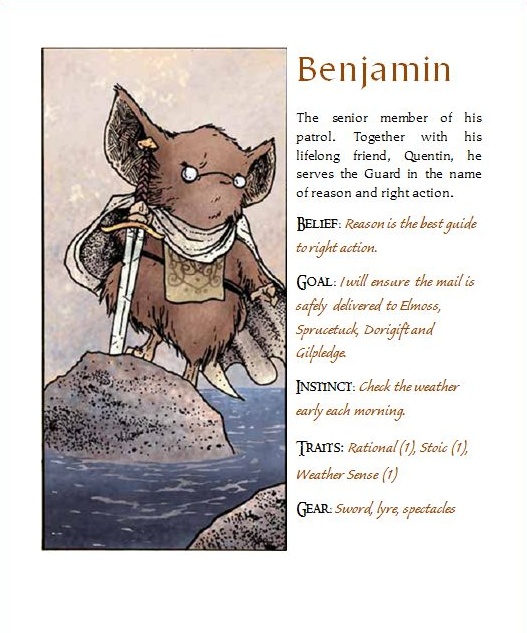
The Deliver the Mail mission seemed like fun so I parceled out the characters to my three players. Jimmy wanted to try playing the leader so decided to play Dain (although re-named to Benjamin), Martin3 decided to play Benjamin's best friend Quentin and Rasmus took the role of the tenderpaw Robin (or Aengus). After first talking a bit about Mouse Guard in general, as Rasmus and Martin3 were pretty much ignorant of the setting, we got into the actual rules system. It's different from what any of us have played before, and while I at least have a passing aquintance with "indie roleplaying" none of the others did. I think Martin3 took it the best since he simply hadn't been roleplaying at all for a number of years. Tabula Rasa and all that I suppose. Jimmy who's regularely GMing for his own group seemed to have the most concern with the system but more in a "this sounds strange, but interesting" way rather than a "not D20=bad!" way. I think we were all really excited to try the game.


The Game Master's Turn
The patrol got their assignement from Gwendolyn; springtime in the territories is a busy season and one important duty of the Guard is to deliver the mail that has been piling up during the winter months. So their mission was to deliver the mail to Elmoss, Sprucetuck and then continuting to the more far off villages of Dorigift and Gilpledge. Before heading out Benjamin requisitioned a packbeetle to carry the mail for them (I would call them lazy except it's pretty cool with a packbeetle). It was a cold and clear spring day and the journey to Elmoss and then Sprucetuck proved uneventful as it was a trip that both Bejamin and Quentin had taken on numerous occasions, both hailing from Sprucetuck. They did manage to exchange some quick words with loved ones before they had to continue their journey to Dorigift. All the while Quentin continued making notes and drawing little squiggles that he could hopefully compile into an actual map later on.

Now they were entering unfamiliar territory as the two villages are quite far off the beaten path. This called for an Obtsacle 6 Pathfinding test and although Quentin tried to Scout ahead and Aengus kept an eye on the sky Benjamin failed the test. While I could have let them find their way but given them a Condition I instead opted for an animal twist. A curious raven began following the patrol, jumping from branch to branch, clearly eyeing that interesting looking mailbag! Suddenly it swooped down, trying to steal the bag from the patrol.

For this we used a Fight Conflict. The raven's Goal was "Must have mailbag!" while the patrol's was "Protect the mail". The raven rolled for composition and got four (which I continued to roll in pretty much every test during the conflict!) while the patrol managed to get five. However, with the raven's high Nature of eight it was still a tough fight. It didn't help that I managed to pick all the right Actions for it in the first round, defending when they attacked and attacking when they feinted. In the second round the raven won the conflict but had lost a little bit of Composition so owed a minor compromise to the patrol. We talked it over and decided that the raven got the mailbag but made a beeline for its' nest - making it easy to track. To be able to track it and then actually get the mail back would require a Hunter test followed by Scout, both versus the raven's Nature of eight (although I think I forgot about hunter and used something else instead).

They managed to track the raven, even with some Traits used against them and then Aengus literally leapt at the opportunity to prove his worth to Quentin by climbing the tree and trying to snatch the mailbag back! Good character moment there. However Aengus failed the test and I thought this was a good opportunity to introduce some Conditions, so Aengus became Tired from all the climbing while both Benjamin and Quentin had become quite Angry at the entire situation. Damn raven! They did manage to get the bag back though and made it the last couple of miles to Gilpledge.

Before even entering the village though, a mouse came running up to them pleading for assistance in getting an old family heirloom back from the fallen city of Walnutpeck. Benjamin wanted primarily to complete the mission but Aengus generous nature and Quentin's inquisitiveness made him give in in the end. They would help the mouse (named Martin) but only after actually delivering the mail. This was a simple Persuasion versus test and Benjamin won the test but felt that his companions both had good points. They continued into Gilpledge and finally delivered the mail.

This was the end of the GM's turn.


The Player's Turn
They had all managed to accrue a couple of Checks each, which made me very happy as I thought it would be a bit difficult during the first session. They started with trying to get rid of their conditions, but obviously the resting place Aengus used wasn't very comfortable and Benjamin just couldn't seem to let go of the whole raven situation! Quentin on the other hand went away for himself, lit up his pipe and sat down with his notes. This relaxed him quite a bit and his anger faded. He then used a check to try and actually compile his notes into a useful map and managed to create and accurate map of the path from Lockhaven to Gilpledge. Goal accomplished! Aengus also used a check for a resource test to get some supplies for the coming journey to Walnutpeck.

The rest of the checks were spent journeying to Walnutpeck and then searching for the rocking chair (the heirloom in question). They failed the first Pathfinding test to find the fallen city and were made Hungry because of it and I was hoping that they would fail the other one as well as I thought it would be fun to introduce some kind of weasel related twist, but they passed it with flying colours. The last couple of checks were used to prepare some food from the supplies Aengus had brought, alleviating their Hungry condition. The player's turn (and the session) ended with the patrol making it back to Gilpledge with the rocking chair.

When handing out rewards everyone got points for playing according to their belief (perhaps a bit generously but it was our first time) and for achieving their respective Goals. Only Quentin earned points for playing his Instinct though. Aengus got the MVP award for bringing the mailbag back and Benjamin got the workhorse award for making a lot of tests during the GM's turn. We all felt that perhaps nobody would get the Embodiment reward this first session, but then we remembered Quentin's little pipe break where he went off for himself. It seemed like a very in-character moment so Martin3 got a point for that.

And that was the end of the session!


Afterthoughts
I for one had a great time, and as far as I could tell the others enjoyed themselves as well. I could tell that they sometimes struggled a bit with the format of Mouse Guard and I know Jimmy isn't entirely comfortable with the meta-gaming aspects and the strict rules of the GM/players' turns. And to be honest I completely understand how he feels. Since I've read the rulebook I probably have a better understanding of the concept and ideas behind this but for a traditional roleplayer to be thrust straight into Mouse Guard can probably be a bit of a system shock. :)

As a GM I felt fairly well prepared as I have read the book a couple of times and have been checking the Burning Wheel forums for newbie problems. I think it went smooth overall and was surprised to see the players collecting a decent amount of checks and creating their own little adventure during their turn (which could easily have become much larger!).

The only thing I felt a bit unsure of was how to handle player initiated tests during the GM's turn. For example, Quentin wanted to roll for Cartography as they went along, but as that wasn't part of a mission obstacle I simply told him to narrate it and then had him use one of his checks in the player's turn to see how the map turned out. Basically, is the GM's turn obstacles only? 100%? Or is there room for some other tests as well? I was very strict this time around, but think I might be a bit more leniant in the future, but also remind the players that all tests are subject to twists or conditions when failed...

Bottom line is that I am very happy with our little session. It lasted a bit over four hours but that was with a dinner break in the middle. It felt just about right! I'm very much in a RPG mixer mood at the moment, I want to try a lot of different games (apart from Mouse Guard there are Diaspora, 3:16, The One Ring, Coriolis, Ashen Stars and Trail of Cthulhu just off the top of my head) but before we jump to the next we will play Mouse Guard for a couple more sessions at least. It's tricky when there's so much cool stuff you want to do!

Oh, and we also tried a three player session of Fiasco which was a lot of fun! More on that later...
9 comments

Thursday, 20 October 2011

Prepping for tomorrow's Mouse Guard!


As I mentioned in an earlier post I've been trying to get some new blood into our roleplaying group. Or, failing that inject my own blood into somebody else's (eww!). With Mouse Guard it ended up being a bit of a mix as we've got parts from another group plus another friend who haven't roleplayed in years. As it happens nobody from my "original group" could make it to tomorrows meeting so it's a new game, a new way of playing and with new people! Should be interesting.

So! I decided to do some prepping! Since preparing the actual adventure is very quick in Mouse Guard (and Burning Wheel as well I imagine) there's more time for doing nifty things like character profiles etc! I decided that we should start out with some pre-generated characters and I went with the group from the Delivering the Mail mission. Although with some name changes.

I put together a summary page for each of the chosen characters (like the one on the right) that also includes his Belief, Goal, Instinct and Traits. I hope this will work as a quick intro to all of the characters and also for easy reference for the other players during the actual session. Also the artwork is awesome and really adds to the feel of the table. I also got a cheap set of poker chips that will be used for Fate points (white), Persona points (black) and Checks (red). There are also some blue and green ones but I'm not sure if I will use them. Perhaps for Disposition during conflicts...

Been thinking a bit about background music and have been considering different soundtracks. Might give some music from the different Fable games a try. Or perhaps Dragon Age. I guess it depends on how well the players know them.

Anyway, just wanted to share that! Will report more on tomorrow's session after the fact. Can't wait!
No comments

Thursday, 13 October 2011

Review of the Mouse Guard RPG Box Set


The other day I finally got the recently released Mouse Guard Roleplaying Game Box Set set in the mail and I thought I would actually take the time and do a proper review of it here.


What's in the box
The meat of the review will naturally be the contents of the main rulebook, but first let's have a look at the actual components in the box. The box itself is surpsisingly sturdy, actually more so than most board games I own (including FFG's that are usually pretty good quality). It has a glossy finish both inside and out and it feels like it will stand the wear and tear of carrying it around. The original hard cover book was released in 2008 and I think the only real difference between it and the book in the box is that it's now soft cover. It seems to be of good quality so I'm not worried about it falling apart. Only time will tell though.


Then there's the new extra stuff: a Game Master's screen, a bunch of cards, 10 mouse dice, a booklet of new rules and missions, player and GM sheets, a map of the mouse territories and five mouse pawns in the style of the ones you see Gwendolyn handle in the comics. Ooh! Lots of juicy stuff!


  • The screen is well designed with things liks skill factors, weapons and animals and their nature listed on it. It is relatively flimsy though, more like how GM screens used to be rather than the heavy linen card stock that we often see today. It's very much an optional accoutrement though so I don't have a problem with that. 
  • There are two cards for each weapon (except for just one mace), three cards for each condition and three cards for each conflict action. They look great and are of a very sturdy, gloss cardstock. I will probably sleeve them although I can't imagine that you would actually need to. Just my anal nature. 
  • The booklet has some new rules for additional weapons (for all the different conflicts) and mounts. There are also a couple of new cities introduced as well as three new missions, one of which is based on the Winter series (think snow, owl and Darkheather). All in all a nice addition!
  • The map is the same you see on the inside cover of the books only it's in full colour. It's a beautiful map but I was hoping that it was going to be larger. It's actually only twice the size of the book which is not bad but... would have liked it larger. Well, hopefully I can find a high resolution image that I can print out nice and large to put in the middle of the table during play.
  • With a map you naturally need some mouse pawns to put on it! You get five of them in a variety of colours and they are very nice. They really don't serve any other function than eye candy but I'm perfectly satisfied with that. Larger than I expected.
  • The new character and GM sheets have been slightly redesigned. First off they're now square to match the books (and the box) and some of the information has been moved around or swapped. Nothing dramatically different but they look a bit nicer.
  • And finally my favourite components; the dice! They are simply fantastic and I was really sad to hear from Luke that extra sets will not be available separately. I'd buy two or three packs right off the bat! There are three ouroboros symbols, two crossed swords symbols and one axe symbol on each die, corresponding with 1-3, 4-5 and 6 respectivally. The symbols are emgraved on the dice, not simply printed on and they look spectacular. Love them!
  • Oh, one final thing that bears mentioning. The box actually comes with a transparant plastic insert that fits on top of all the books and sheets which has room for the pawns and cards as well. It seems to be designed with reusability in mind and will serve to keep all the components in place when you put the lid on the box. A nice touch!


Bottom line is that the production values and design of this box is through the roof. Sure, the book isn't hardback and the screen is kind of flimsy, but apart from that it really deserves the highest praise!


Now, onto the rulebook and the game itself.


The Game
I've been reading the PDF while waiting for the hard copy and it's one of, if not the most interesting RPG product I've read to date. I'm not saying it's necessarily the best roleplaying game but it's certainly one of the best roleplaying books.

I first came in contact with the Burning Wheel system and Luke Crane a couple of years ago when I first started looking around for alternatives to what I suppose broadly could be called "traditional roleplaying games" (incidentally that is also when I discovered Diaspora and FATE). I read through the Hub and Spokes and while the concepts therein were absolutely fascinating I was also wary how well the system would go across with my regular gaming group. So I kind of filed it among the other would-like-to-play-sometime-games and left it at that.

I had heard about Mouse Guard at this time but the subject matter didn't appeal to me (mice with swords? What?) and I hadn't really made the connection with Burning Wheel. Nonetheless I had of course noticed that it was very popular. Then a couple of months ago something made me  want to read more about Mouse Guard, and I'm glad I did!

I got the PDF and as I started reading I simply could not put it down. For a grizzled old roleplayer like myself reading about radically different concepts and ideas like this is a novel experience! Sure, there are buttloads of RPGs out there with all manners of neat mechanics and interesting rules, but very few of them put half as much thought in how to actually create the story, play the characters and how it all ties into the mechanics as Mouse Guard does. This kind of nonconformity are almost immediately apparent just from the layout of the book.

Pretty much all RPGs I've read so far have started with talking about what an RPG is, then they describe character creation, then probably skills and abilities followed by weapons and equipment and finally a world section and a GM's section. You know how they all look, right? In Mouse Guard the chapter for character creation is the last in the book! Skills and Traits are just ahead of it and the book starts with what is actually the core of Mouse Guard: how to truly play your character - not from a numbers standpoint but from a roleplaying one. There aren't many equipment rules so they're covered in the Resolution chapter and the information about the world is sprinkled throughout the book (although you could argue that the Seasons and The Territories chapters are the "world chapters"). So what about the GM's section? Well, there is a chapter for it (The Mission) but to be perfectly honest the entire book is like a guide to Game Masters everywhere!


I will try to make a short summary of the essential concepts of Mouse Guard (the spokes!) for those of you out there who have no idea what I'm on about.

I think the core idea is to more closely integrate roleplaying with the actual mechanics of the game and to try and make the story more "alive". In traditional RPGs the mechanics are pretty much disassociated from any actual roleplaying that might or might not be going on. The mechanics are the gamey bits provided by the book and the roleplay bits are supposed to be provided by the players. In Mouse Guard these two are very much integrated and to be able to play the game you will have to actually roleplay your character.

To create this integration each character has a Belief (a snapshot view of how the characters thinks and reasons), an Instinct (something your character does without really thinking) and several Traits (one word descriptions) that further helps fleshing out your character.

Your Belief is the main guide on how your character should be played. If, during play, you're not quite sure what to do in a certain situation you can simply read over your belief and think about how your character would act. It also serves as a reminder for the rest of the group what kind of character you play. This is not to say that your Belief is some kind of rule that you have to follow. While you do get rewarded with Fate points when acting according to your belief you also get rewarded with Persona points for acting against it (since it shows the difficult decision your character faced and potential character development). Instincts also net you bonus points if you use them at the right time, mind you the right time does not necessarily mean the best time. Having an instinct like "I always draw my sword at first sign of trouble" can be just as much a detriment as a boon.

And finally we have Traits. If Beliefs are the overarching concept of the character, the Traits are the meat and bone of it. Traits are simple statements like Tall, Stoic, Inquisitive, Sceptical etc and is yet another way to develop your character's thoughts and habits. Traits can be used to receive bonus dice to your tests ("I'm Sceptic, don't you think I should get a bonus die for resisting that Deceive attempt?") which is all well and good but the real punch comes from how you can use the Traits against yourself during play ("I'm Sceptic so I probably don't believe that a weasel army is marching against Lockhaven"). Purposefully tripping yourself up like this helps to further develop your character and also earns you Checks that can be spent later. For those of you familiar with FATE this mechanic is rather similar to how Aspects work in that game.


Now, Fate and Persona points can be used at any time to allow you to add extra dice or re-roll bad ones, but Checks (that you earn from traits) can only be used during the players turn. "What the hell is the players turn? I thought this was a roleplaying game!" I hear you say. Yes, this is another very different concept that you'll find in Mouse Guard. Each session is made up of the GM's turn, in which the guardmice are sent on a mission and need to overcome a number of obstacles set before them by the GM. However, once they accomplish the mission (or this leg of the mission at least) the reins are handed over to the players and they get to take the initiative instead. However, to be able to take actions and roll dice during the players turn you need to use the Checks that you earned in the GM's turn from using your Traits against you. 

This concept of the GM's turn and the Players' turn is probably what had me most perplexed when reading Mouse Guard, and I know I'm not alone. However you need to remember that the entire structure of Mouse Guard is completely different from traditional RPGs. Someone somewhere likened the turns with playing Grand Theft Auto. When you go on a mission in Mouse Guard it's like when you go on a mission in GTA - you have some specific instructions on what to do and certain obstacles are set before you. And all the other time where you just ride around and do whatever you want, be it robbing people or buying new guns, is the players turn in Mouse Guard. It's not a perfect allegory but it's close enough I think. During their turn the players can try to heal up if needed, tie up loose ends, visit friends or relatives or even start a conflict of their own choosing if they want. It's worth mentioning that this kind of balance exists in pretty much all RPG's, only not to such a formal extent. In actual play I think it will feel more natural and I'm very interested to see the Checks economy in work.

So that's a little bit about the character part of Mouse Guard. And if you haven't noticed by now it is the main part -  the characters are the game. It's not about the mission it's about how your characters act during the mission. This really can't be stressed enough and it's what has me so excited about Mouse Guard; 100% character driven! The mission is simply a framework and there are no guaranties it will go as initially envisioned, as a matter of fact it probably won't...

And this leads into the other big thing with Mouse Guard: there's no failure. Yes, you can fail a test and not make it over that river, or not find the path to that village or get defeated by that badger but that isn't a failure from a story standpoint it simply leads it into a different direction. When a player fails a test the GM can either allow him to succeed anyway, but with a condition (like Hungry, Tired or Angry) or he could introduce a Twist! When using a Twist the character does fail to accomplish what he set out to do, but something is added to the mix. Perhaps you get swept downstream straight into a weasel patrol! Or maybe you get lost on your way to the village and the cold spring rain turns into snow forcing you to seek shelter. Or the badger chase you into a hole leading into the Darkheather. Basically your "failure" drives the story forward creating new events and opportunities. At times the story can take a completely different turn from what the GM had in mind from the beginning, going from Twist to Twist to Twist!

This kind of organically growing roleplaying again helps to put the character in the center as there's no wrong way of playing. As long as you simply play your character the story will unfold naturally. In fact when GMing Mouse Guard what should be first in your mind is not the nitty gritty of the mission but the Beliefs, Instincts and Traits of the characters. As long as you challenge them you will have a solid play experience. Or as Luke puts it in the text:
"There’s an easy trick to it: Lean on the players’ Beliefs; interfere with their Goals, trigger their Instincts and stomp on their traits!"
As a player you should actively try to put yourself at risk by using your Belief, Instincts and Traits not only when it's beneficial but also when they get in your way. It's very liberating not to have to worry about failing an important roll, or failing to do the right thing during a mission - it will just drive the story into new unexplored territory!


In summary, this is a book that I think every roleplayer should read. It doesn't matter if you don't like the subject matter (mice with swords!) or if you will ever actually play the game or not, but just reading it will change the way you think about roleplaying games in general. When I first read Diaspora/FATE it had a similar effect on me but with Mouse Guard (or Burning Wheel) it was much more pronounced.


Speaking of the subject matter, as I said in the beginning of this review my initial thought was that I would read Mouse Guard and if I liked the system transplant it into another setting (Warhammer Fantasy to be precise). But as I was reading the book the world of Mouse Guard really came alive and I became more and more interested in it. I read the many examples in the text featuring Lieam, Kenzie, Saxon and Sadie and my curiosity kept growing. In the end I ordered the three Mouse Guard books released so far and they are spectacular!


While the stories are fairly straight forward the characters and the art really puts them a level above the competition. Mouse Guard are no childrens stories (although they could be read by kids) and are certainly not light or "whimsical" as The D6 Generation's Craig put it. In fact, to me at least, they have a kind of weight to them that I feel are comparable to... dun-dun-DUN, the Lord of the Rings. Yes, also very different naturally, but the way that they are similar is that when you read Mouse Guard, just as when you read LotR, you simply accept the story fully and at no time does it become anything less than serious. Especially Winter 1152 which is both so dark and so epic. The owl could easily be compared to the Balrog of Moria and their respective battles are equally epic. Ooh, getting chills just thinking about it!


So not only has Mouse Guard provided me with a fantastic new system to try but it has also introduced me to a completely new world. So now I'm doubly excited to play the game - partly to use the system and partly to begin exploring the Territories!


Conclusion
There are of course still many things I haven't even mentioned, like the conflict system, the importance of weather and the seasons or the large part the guardmice's Nature play in the game. But I still hope that I have managed to give you an inkling about what's between the covers of Mouse Guard. It's completely different to what most of us are used to, at the same time being more structured and more free.


Ironically I think that Mouse Guard is probably more accessible to people who are not experienced roleplayers. We simply have too much baggage and too many notions about how a roleplaying game "should" be that we simply have a hard time grasping this radical new concept. I listened to the Minions of the Monster Master's playthrough of Mouse Guard and I could tell that they were struggling with wrapping their heads around this new system. They definitely seemed to enjoy themselves (right?) but the phrase "I just don't get why ..." was uttered on more than one occasion. And I don't blame them! I imagine my first venture into Mouse Guard/Burning Wheel territory will be a similar experience. However, this is part of what makes Mouse Guard great!


Even if you never intend to actually play the game the book is worth reading simply for all the new thoughts and ideas it will put in your head and I think it will make you a better roleplayer in general. Be it as a Game Master or a player. So, if you are a roleplayer, buy this book (or PDF. It's only $20) and read it. It's that simple. For those of you out there who are looking for a numerical rating this is clearly a 5 out of 5.


Tomorrow I'm heading over to my sisters house to see my eight year old niece and I will bring Fall 1152 with me to read to her. But before I go, I just might head to town and treat myself to Burning Wheel Gold...
6 comments